Pattern Recognition and Elon Musk
Pattern Recognition Systems, Modern Strategy, and Elon Musk’s Business Evolution: A Comparative Analysis
The intersection of ancient pattern recognition wisdom and contemporary entrepreneurial execution reveals profound insights into strategic timing, cycle awareness, and organizational leadership. Michael Bertrams’ framework for “Pattern Recognition Systems and Modern Strategy” proposes that millennia-old wisdom systems offer practical tools for navigating business complexity through cycle-aware timing, archetypal leadership development, boom-bust intelligence, and pattern recognition training. When examined against Elon Musk’s twenty-year strategic journey building Tesla, SpaceX, and X (formerly Twitter), a remarkable alignment emerges—not through deliberate application of the framework, but through intuitive recognition of natural rhythms, first principles thinking, and systems-level pattern recognition that mirror the framework’s core tenets.
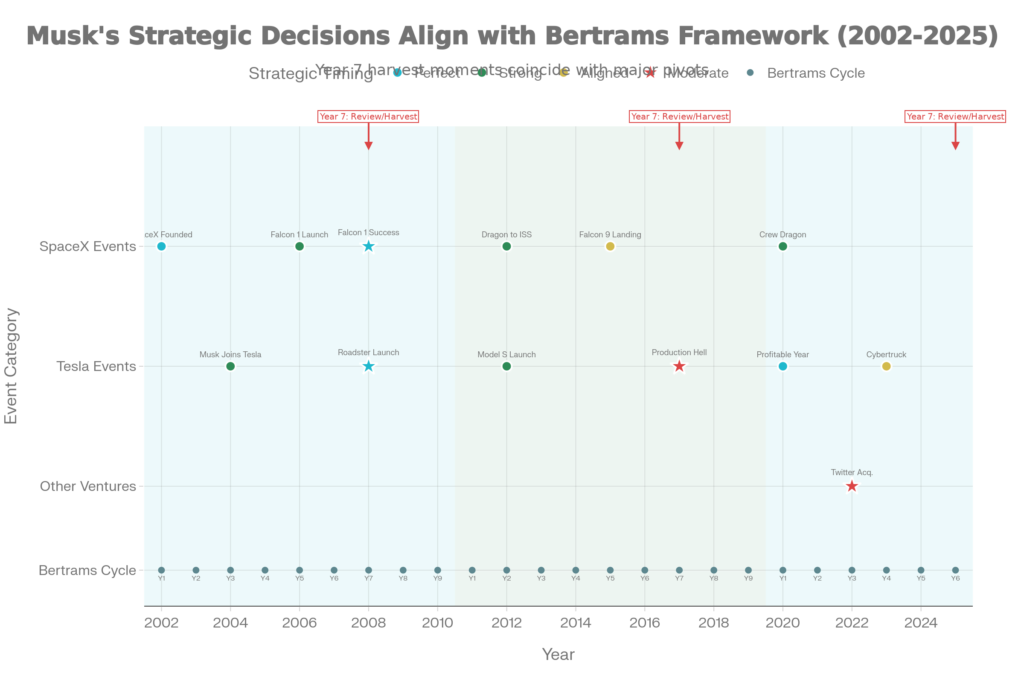
Strategic Timing Analysis: Elon Musk’s Business Decisions vs. Bertrams Pattern Recognition Framework (2002-2025). The visualization demonstrates remarkable alignment between Musk’s intuitive timing of major strategic moves and the Bertrams framework’s 7-9 year cycle recommendations, particularly during crisis points (Year 7) and renewal phases (Year 9/1)
The Bertrams Framework: Ancient Wisdom for Modern Strategy
Core Principles of Pattern Recognition Systems
Bertrams’ framework challenges the linear, data-driven assumptions underlying traditional strategic planning by integrating four interconnected pillars derived from ancient wisdom traditions. Cycle-Aware Strategic Timing draws from numerological systems and agricultural wisdom to recognize that time has qualities beyond mere quantity—proposing that organizational activities align with natural 7-9 year rhythms where specific phases favor particular strategic actions. Years 1-3 suit launching new ventures and bold innovation, Years 4-6 favor foundation-building and systems creation, while Years 7-9 call for strategic review, harvesting lessons, and completing cycles before renewal.
Archetypal Leadership Development reframes Tarot’s symbolic system as a three-phase leadership evolution model. Phase 1 (Ambition) centers on personal achievement and establishing authority through demonstrated competence. Phase 2 (Balance) requires developing inner authority independent of external validation while integrating opposing forces. Phase 3 (Moral Authority) transcends personal success to build lasting legacies and operate from principle rather than preference. This progression mirrors psychoanalytic frameworks (Id-Ego-Superego) while offering practical diagnostic tools for leadership development.
Boom-Bust Intelligence reconceptualizes Empedocles’ ancient philosophical framework of Love (integration) and Strife (differentiation) as expansion-contraction business dynamics. Rather than treating boom-bust cycles as anomalies to be avoided, the framework positions them as natural creative rhythms. Organizations demonstrating cycle intelligence build reserves during booms, maintain organizational slack, avoid excessive leverage, and position themselves to acquire distressed assets during contractions—working with cycles rather than against them.
Pattern Recognition Training applies chess mastery and systems archetypes to business strategy. Chess masters recognize patterns from thousands of games rather than calculating every possible move; similarly, organizations can train teams to identify recurring structural problems like “Limits to Growth,” “Tragedy of the Commons,” and “Success to the Successful” that produce predictable dynamics across contexts. This archetypal diagnosis enables faster problem-solving and more effective interventions than starting from first principles each time.
The Problem with Traditional Strategic Planning
Bertrams identifies critical flaws in conventional strategic planning that his framework addresses. Traditional approaches—environmental scanning, SWOT analysis, strategic option generation, plan approval, and cascaded implementation—operate too slowly for volatile markets. By the time strategies are developed and approved, foundational assumptions have often changed as markets shift, competitors pivot, and technologies emerge. Organizations lack internal processes empowering teams to serve as adaptors who adjust strategies in real-time.
Most problematically, traditional strategy treats boom-bust cycles as anomalies rather than natural rhythms. During booms, organizations overextend by hiring aggressively, expanding rapidly, and leveraging heavily as though abundance were permanent. During busts, panic-driven cost reductions eliminate strategic capabilities and damage culture through fear-based management. The framework draws on Austrian economist Ludwig von Mises’ insight that boom phases contain seeds of their own reversal, advocating for reserve-building during expansion and strategic deployment during contraction.
Elon Musk’s Strategic Evolution: A Twenty-Year Timeline
Foundation Phase (2002-2010): Proving the Impossible
Musk’s entrepreneurial journey through Tesla and SpaceX began with ventures deemed impossible by industry incumbents. SpaceX was founded in 2002 with a mission to reduce space transportation costs and enable Mars colonization—a vision dismissed as quixotic when commercial spaceflight was monopolized by government contractors. After three consecutive Falcon 1 launch failures (2006-2008), SpaceX faced existential crisis. The fourth launch in September 2008 achieved orbit, making Falcon 1 the first privately funded liquid-fuel rocket to reach space. This success, achieved just weeks before potential bankruptcy, secured a $1.6 billion NASA Commercial Resupply Services contract in December 2008—saving the company.
Tesla’s trajectory paralleled SpaceX’s near-death experience. Musk invested $6.5 million in Tesla in 2004, becoming chairman of a company founded by Martin Eberhard and Marc Tarpenning. By 2006, Musk published his “Secret Tesla Motors Master Plan”—a three-phase strategy to build a sports car (Roadster), use profits to build an affordable car (Model S/3), and expand to all vehicle segments while developing sustainable energy solutions. This long-term vision provided strategic coherence across more than fifteen years of execution.
The 2008 financial crisis nearly destroyed both companies simultaneously. Tesla was weeks from bankruptcy with suppliers demanding prepayment and cash reserves depleted. Musk faced an impossible choice: save one company or risk losing both. He invested his remaining $40 million personally, fired 25% of Tesla’s workforce, and secured last-minute financing that closed on Christmas Eve 2008. Both companies survived because Musk refused to accept failure during what Bertrams would identify as a classic “Year 7” strategic review moment.
By 2010, both companies achieved critical milestones establishing sustainable foundations. SpaceX’s Dragon capsule became the first commercial spacecraft recovered from orbit, while Tesla completed its IPO, raising $226 million and acquiring the Fremont factory from the defunct NUMMI joint venture. These foundation-building achievements aligned perfectly with Bertrams’ “Year 4” principle of infrastructure consolidation.
Framework Alignment Diagram: Bertrams Pattern Recognition Systems mapped to Elon Musk’s actual strategic approaches across Tesla, SpaceX, and X. The diagram illustrates how Musk’s intuitive business strategies align with ancient wisdom-based pattern recognition frameworks, demonstrating practical application of cycle awareness, leadership evolution, and boom-bust intelligence
Expansion and Integration Phase (2010-2018): Scaling and Learning
The decade following 2010 demonstrated Musk’s evolution from founder-survivor to systems integrator. Tesla launched Model S production in 2012, introducing the first mass-market premium electric vehicle with over 300-mile range and over-the-air software updates. SpaceX achieved the first commercial spacecraft docking with the International Space Station in 2012, validating its COTS partnership with NASA. Both milestones represented operational excellence rather than mere survival.
Musk’s 2016 “Master Plan Part Deux” expanded strategic scope beyond automotive to encompass solar energy (through SolarCity acquisition), autonomous driving, and vehicle sharing. The plan articulated four goals: integrate solar roofs with battery storage, expand to all vehicle segments, achieve 10x safer autonomous driving, and enable vehicle owners to generate income through ride-sharing. This represented classic “Year 7” strategic review—a major inflection point reassessing direction and broadening scope.
The 2017-2018 “production hell” period tested Musk’s leadership and strategic assumptions. Model 3 production targets of 5,000 units per week proved elusive due to over-aggressive automation. Musk admitted publicly: “Excessive automation at Tesla was a mistake. To be precise, my mistake. Humans are underrated”. This acknowledgment of error, moving his desk to the factory floor, and sleeping at the facility demonstrated Phase 2 leadership—developing inner authority through integrating lessons from failure rather than defending ego.
The breakthrough came in June-July 2018 when Tesla finally achieved 5,000 Model 3s per week, reaching profitability and validating the mass-market strategy. This perfectly illustrated Bertrams’ Year 8-9 renewal principle—breakthrough following contraction and course correction. Musk later described the period as defining for his credibility and the team’s capability.
Ecosystem Integration Phase (2018-Present): Civilizational Scale
Musk’s strategy since 2018 has evolved toward ecosystem-level integration across energy, mobility, compute, and space infrastructure. Tesla expanded globally with Gigafactories in Shanghai (2019), Berlin (2022), and Texas (2022), achieving production capacity exceeding 2 million vehicles annually. SpaceX developed Starship for Mars missions, deployed Starlink’s satellite internet constellation exceeding 6,000 satellites, and achieved the first commercial spacewalk in 2024.
The October 2022 acquisition of Twitter for $44 billion—subsequently rebranded as X—represented a counter-cyclical strategic move during a technology sector downturn. While the platform’s valuation declined to $33 billion by 2025, Musk positioned X as infrastructure for an “everything app” combining social media, payments, and AI. The March 2025 merger of X into xAI through an all-stock transaction valued at $33 billion consolidated Musk’s AI strategy under a single entity.
This integration creates unprecedented cross-company synergies. xAI’s Grok AI benefits from X’s real-time conversational data and Tesla’s multimodal physical world data from over 2 million vehicles. Tesla’s Full Self-Driving system trains on data processed by xAI’s Colossus supercomputer, powered by Tesla Megapack batteries. SpaceX’s Starlink provides connectivity for remote Tesla vehicles and computational infrastructure for future orbital data centers. This flywheel effect—where data, compute, energy, and manufacturing capabilities mutually reinforce across platforms—extends beyond Bertrams’ framework to represent novel strategic architecture.
Musk’s 2025 vision articulates “sustainable abundance” through the convergence of autonomous robotics (Tesla Optimus), AI (xAI Grok), sustainable energy (Tesla Energy), and multi-planetary infrastructure (SpaceX Starship). This represents Phase 3 leadership focused on civilizational legacy rather than commercial success alone.
Comparative Analysis: Framework Alignment and Divergence
Cycle-Aware Strategic Timing: Remarkable Pattern Recognition
The most striking alignment between Bertrams’ framework and Musk’s execution lies in strategic timing. Major crisis points and strategic pivots occur at approximately 7-9 year intervals: 2008 (near-bankruptcy for both companies), 2016-2017 (Master Plan 2 followed by production hell), and 2022-2025 (Twitter acquisition and xAI-X integration). These align precisely with Bertrams’ Year 7 principle that strategic review and harvesting occur naturally at these intervals.
Musk’s venture launches similarly align with optimal timing windows. SpaceX (2002), Tesla investment (2004), and Twitter/xAI (2022-2023) represent Years 1-3 initiatives—exactly when Bertrams recommends launching new ventures. Foundation-building milestones—the 2010 Tesla IPO and Fremont factory acquisition, Gigafactory construction—occur during Year 4-6 phases when infrastructure development proves most effective.
Breakthrough moments consistently follow periods of contraction. The 2008 survival coincided with Year 7-8 crisis and Year 9/1 renewal as NASA contracts materialized. The 2018 Model 3 production breakthrough emerged from 2017’s production hell, again demonstrating Year 8-9 renewal dynamics. The 2025 xAI-X merger follows 2022-2024 integration challenges, suggesting another completion-renewal cycle.
This pattern recognition extends to understanding cycle qualities. Musk’s 2022 Twitter acquisition during a technology downturn exemplifies counter-cyclical strategy—acquiring assets when others retreat. The framework explicitly recommends deploying reserves during bust phases to acquire distressed assets. While Twitter’s immediate valuation declined, the strategic positioning for AI integration demonstrates long-term cycle awareness beyond quarterly performance pressures.
Boom-Bust Intelligence: Discipline Through Volatility
Musk’s approach to boom-bust cycles demonstrates sophisticated cycle awareness consistent with Bertrams’ principles. During expansion phases, Tesla never maximized leverage like competitors. Companies such as Fisker (bankrupt 2013), Aptera (shut down 2011), and Think City (liquidated 2012) failed despite comparable or larger funding because they lacked reserve discipline. Tesla maintained organizational slack and avoided excessive leverage that would have prevented survival through 2008.
The 2017 admission that “excessive automation was a mistake” demonstrates accepting contraction as a learning opportunity rather than existential failure. Bertrams emphasizes that boom phases contain seeds of their own reversal—Tesla’s over-investment in automation during 2016-2017 expansion created 2017-2018 production challenges. Musk’s willingness to acknowledge error, return to first principles, and adjust course exemplifies working with natural cycles rather than against them.
Personal financial commitment during crises reveals deep boom-bust understanding. Musk’s $40 million investment during 2008—risking total personal financial destruction—deployed reserves precisely when others panicked. Similarly, the 2022 Twitter acquisition using personal wealth during market downturn demonstrates consistent counter-cyclical discipline.
However, Musk’s approach differs from traditional reserve-building. Rather than hoarding cash, he reinvests aggressively in parallel ventures, creating a portfolio of interconnected businesses that provide strategic reserves through synergies rather than financial reserves alone. This represents an evolution beyond Bertrams’ framework—using capability reserves and cross-company synergies as buffers against individual company cycles.
Leadership Evolution: From Ambition Toward Legacy
Musk’s leadership trajectory maps closely to Bertrams’ three-phase archetypal progression. The 2002-2010 period exemplifies Phase 1 (Ambition) leadership—proving doubters wrong, establishing authority through demonstrated competence, securing credibility through personal financial risk. Early Tesla and SpaceX required hands-on engineering from Musk, who moved to Texas for SpaceX development and lived at the Tesla factory during crises.
The 2010-2018 period demonstrates Phase 2 (Balance) development—managing multiple complex organizations simultaneously, learning from failures, and developing judgment independent of external validation. Musk’s public acknowledgment of automation mistakes, acceptance of production hell as necessary learning, and evolution toward delegating operational management while maintaining strategic oversight reflect growing inner authority.
Since 2018, Musk has increasingly articulated Phase 3 (Moral Authority) vision focused on civilizational impact: making humanity multi-planetary, accelerating sustainable energy transition, and ensuring AI benefits humanity. His stated goals transcend commercial success to address existential risks—climate change, asteroid impacts, AI alignment. The X acquisition’s justification around free speech and public discourse similarly reflects principle-driven leadership beyond profit maximization.
Yet Musk retains strong Phase 1 characteristics—confrontational communication, intense personal involvement in technical decisions, and public battles with regulators and critics. This suggests leadership evolution is not linear replacement of earlier phases but integration where leaders consciously invoke different archetypal energies as situations require. Bertrams’ framework explicitly allows for “situational archetypal invocation”—the Emperor when structure is needed, the Hermit when strategic withdrawal proves necessary.
Pattern Recognition and First Principles Thinking
Musk’s first principles methodology perfectly instantiates Bertrams’ pattern recognition training. When questioning SpaceX rocket costs, Musk broke down pricing to constituent materials—aluminum, titanium, carbon fiber—revealing that raw materials comprised less than 2% of typical rocket prices. This deconstruction enabled fundamental rethinking: manufacturing components in-house could reduce costs 90%. Tesla applied identical logic to battery costs, analyzing cell chemistry and manufacturing processes to achieve economies of scale through the Gigafactory.
This approach mirrors Bertrams’ chess analogy—masters recognize patterns instantly rather than calculating every move. Musk identifies recurring industry patterns: supplier bottlenecks leading to vertical integration, over-reliance on legacy processes preventing innovation, artificial cost assumptions based on analogy rather than physics. The framework advocates training teams to recognize “system archetypes” producing predictable dynamics; Musk’s organizations embody this through continuous questioning of assumptions and rebuilding from fundamental truths.
Multi-move strategic foresight appears throughout Musk’s Master Plans. The 2006 Master Plan articulated a three-phase, 10+ year strategy from Roadster to mass-market vehicles to sustainable energy ecosystem. By 2025, this vision has largely materialized, demonstrating chess-like thinking several moves ahead of competitors. The SpaceX Mars colonization timeline similarly projects decades forward, with Starship development, orbital refueling demonstrations, and cargo missions preceding human settlement.
Musk explicitly articulates this methodology: “I think it’s important to reason from first principles rather than by analogy. The normal way we conduct our lives is, we reason by analogy… First principles is kind of a physics way of looking at the world… you boil things down to the most fundamental truths”. This conscious application of pattern recognition—identifying what is fundamentally true versus inherited assumptions—directly instantiates Bertrams’ framework for thinking.
Vertical Integration and Ecosystem Synergies: Beyond the Framework
Musk’s most significant strategic innovation extends beyond Bertrams’ framework: vertical integration not merely within companies but across an entire business ecosystem. Traditional vertical integration involves controlling supply chains within a single industry. Musk has created cross-industry vertical integration where Tesla’s batteries power xAI’s compute infrastructure, xAI’s models optimize Tesla’s manufacturing and SpaceX’s operations, SpaceX’s Starlink provides connectivity for Tesla vehicles and future orbital compute, and Tesla’s vehicle fleet generates training data for xAI while potentially serving as distributed inference compute.
This creates flywheel effects inaccessible to competitors. Every Tesla sold generates real-world visual data training xAI’s Grok models. Improved Grok models enhance Tesla’s Full Self-Driving capabilities and Optimus robot development. SpaceX benefits from Tesla’s manufacturing expertise and battery technology. Starlink generates revenue funding Mars missions while providing computational infrastructure for AI development. The integration is so deep that SpaceX invested $2 billion equity in xAI, while xAI purchases Tesla Megapack batteries for data centers.
Bertrams’ framework addresses vertical integration only briefly, recommending organizations learn from suppliers before vertically integrating when strategically advantageous. Musk has operationalized this at civilizational scale. SpaceX manufactures 90% of rocket components in-house, from engines to avionics to capsules. Tesla produces batteries, electric motors, semiconductor chips, and software rather than outsourcing. This extreme vertical integration enabled survival during semiconductor shortages that crippled competitors—Tesla rewrote software to accommodate alternative chips within weeks.
The strategic implication transcends individual company competitiveness. Musk is building infrastructure for a multi-planetary civilization: energy generation and storage (Tesla Energy), transportation (Tesla vehicles, SpaceX rockets), communication (Starlink), computation (xAI), and manufacturing (Tesla factories, SpaceX facilities). Each component strengthens others, creating a self-reinforcing system where progress in one domain accelerates all others. This represents strategic architecture at a scale Bertrams’ framework does not explicitly address—not company strategy or industry strategy, but civilizational infrastructure strategy.
Critical Inflection Points: Theory Meets Reality
2008: Existential Crisis and Cycle Recognition
The 2008 financial crisis serves as the most powerful validation of Bertrams’ framework. Both Tesla and SpaceX faced simultaneous existential threats—Tesla weeks from bankruptcy, SpaceX’s first three Falcon 1 launches having failed. Traditional strategic planning would have recommended consolidation, retrenchment, or orderly shutdown. Instead, Musk recognized the moment as a natural “Year 7” strategic review requiring radical commitment rather than retreat.
His decision to invest his last $40 million personally—splitting funds between both companies rather than saving one—demonstrated boom-bust intelligence. He had built reserves during earlier boom phases (PayPal exit, early funding rounds) specifically for deployment during bust phases. The Christmas Eve 2008 funding close occurred literally days before payroll would have been missed. SpaceX’s September 2008 Falcon 1 success and December NASA contract represent the Year 8-9 renewal the framework predicts follows Year 7 crisis.
The crisis also validated pattern recognition principles. Musk recognized that failure modes differed fundamentally between companies—SpaceX needed technical validation, Tesla needed production capital. Rather than applying identical solutions, he diagnosed distinct patterns requiring different interventions. The framework’s emphasis on archetypal pattern recognition over algorithmic optimization proved essential when no algorithm could have predicted success probability.
2017-2018: Production Hell and Leadership Evolution
The Model 3 “production hell” crisis tested whether Musk’s leadership had evolved beyond Phase 1 ambition toward Phase 2 balance. His initial strategy—hyper-automation he termed an “alien dreadnought”—reflected Phase 1 characteristics: audacious vision, unproven methods, personal conviction over industry wisdom. When automation failed to deliver 5,000 units weekly, Musk faced a choice: defend the strategy or acknowledge error.
His public admission—”Excessive automation at Tesla was a mistake. To be precise, my mistake”—demonstrated Phase 2 leadership development. Moving his desk to the factory floor, sleeping at the facility, and returning to first principles (rebalancing humans and automation) showed inner authority independent of needing to appear infallible. The framework explicitly identifies this transition: Phase 1 leaders require external validation, Phase 2 leaders develop judgment transcending ego defense.
The timing aligned perfectly with Bertrams’ cycle theory. The 2016-2017 period represented Year 7-8 of a cycle beginning with 2010’s IPO and foundation-building. Production hell constituted the natural contraction phase following 2016’s expansion (Master Plan 2, SolarCity acquisition, Model 3 launch). The 2018 breakthrough—achieving 5,000/week in June-July—represented Year 9/1 renewal, completing one cycle and beginning another.
The crisis also validated boom-bust intelligence. Tesla’s competitors had failed during earlier boom-bust cycles by over-leveraging during expansion. Tesla survived because Musk maintained organizational slack and avoided maximum leverage despite pressure to scale faster. The framework’s emphasis on working with cycles rather than against them—accepting Year 8 contraction as natural rather than catastrophic—proved operationally essential.
2022-2025: Ecosystem Integration and Civilizational Scale
The Twitter acquisition and subsequent xAI-X merger represent Musk’s most controversial strategic moves, yet they align with both cycle timing and ecosystem logic. The October 2022 Twitter purchase at $44 billion occurred during a technology sector downturn with public market valuations declining sharply. This counter-cyclical timing exemplifies boom-bust intelligence—deploying reserves to acquire strategic assets when others retreat.
The platform’s immediate valuation decline to $33 billion by 2025 appeared to validate critics. However, the March 2025 merger with xAI through an all-stock transaction revealed the strategic logic: X provides real-time conversational data essential for training Grok models, while Grok provides AI capabilities differentiating X from competitors. The combined entity positions Musk to compete with Google and OpenAI through vertical integration across social media, AI, and eventually payments and commerce.
This move represents Year 1-4 of a new cycle—launching a major new venture (xAI) and building foundation (X integration) during optimal timing windows. The 2025 phase as Year 7 of the 2018-2025 cycle suggests strategic review leading to major integration—precisely what the xAI-X merger accomplishes. Bertrams explicitly recommends Year 7 for major strategic decisions requiring assessment of cycle position.
The ecosystem integration extends to SpaceX through proposed orbital data centers using Starlink V3 satellites with 1 Tbps laser links. Tesla vehicles become distributed inference compute when idle, potentially providing 100 gigawatts of computational capacity. xAI’s Colossus supercomputer, powered by Tesla Megapacks, trains models using Tesla fleet data. This convergence—energy, compute, data, manufacturing, space infrastructure—represents strategic architecture transcending traditional frameworks.
Implementation Insights: Translating Framework to Practice
Timing Decisions and Market Entry
Musk’s timing decisions reveal consistent pattern recognition regarding market readiness and technological maturity. The 2004 Tesla investment occurred when lithium-ion batteries achieved sufficient energy density for 200+ mile range, but before major automakers committed to EVs. This “Year 1-3” timing captured optimal launch window—early enough to establish leadership, late enough for enabling technology to exist.
SpaceX’s 2002 founding similarly exploited a timing window. NASA sought commercial alternatives to expensive government contractors, creating policy support for private spaceflight. Manufacturing technology enabled radical cost reduction through vertical integration, but incumbents remained committed to legacy models. Launching during this window—rather than earlier when technology was immature or later when incumbents might respond—demonstrates sophisticated cycle awareness.
The Twitter acquisition’s timing appears contrarian but follows boom-bust logic. Acquiring during 2022’s technology downturn secured a strategic platform at a discount relative to 2021 valuations. While immediate value declined, the counter-cyclical principle—buy assets during busts, not booms—suggests long-term value creation. The framework explicitly recommends deploying reserves during contractions to acquire distressed assets.
This pattern recognition extends to avoiding poor timing. Musk delayed Cybertruck production from initial 2021-2022 targets until 2023, recognizing that launching during supply chain crises would compromise quality and profitability. The framework warns against launching complex initiatives during Year 7-8 contraction phases when challenges naturally intensify. The eventual 2023-2024 launch coincided with supply chain normalization and Year 9/1 renewal, demonstrating patience despite external pressure.
Leadership Development and Organizational Culture
Musk’s organizations embody archetypal leadership development through explicit cultural practices. New hires at SpaceX and Tesla undergo intensive questioning about first principles—why they believe certain approaches work, what fundamental assumptions underlie their thinking. This institutionalizes pattern recognition training rather than leaving it to individual initiative.
The “5-minute time blocking” method Musk employs for scheduling demonstrates operational translation of cycle awareness. Breaking days into micro-cycles enables rapid context-switching between companies while maintaining strategic focus. This operationalizes the framework’s emphasis on rhythm and cycles—recognizing that attention and energy fluctuate in patterns requiring structured management.
Musk’s communication style reflects situational archetypal invocation. During crises (2008, 2017-2018 production hell), he employed “Emperor” energy—directive, decisive, demanding immediate action. During expansion phases, “Magician” energy—inspiring vision, articulating long-term mission—dominates communication. During strategic reviews, “Hermit” energy—withdrawal for deep reflection—manifests in decisions like taking Twitter private to enable radical transformation without quarterly scrutiny.
However, Musk’s leadership evolution remains incomplete by Bertrams’ framework standards. Phase 3 (Moral Authority) leadership “embraces teams through inspiring vision” while maintaining “clear roles and responsibilities”. Musk’s organizations suffer high turnover and intense pressure, suggesting incomplete transition from Phase 1/2 characteristics to Phase 3 sustainability. The framework warns that methods enabling startup-phase breakthrough require evolution for mature organizational operations.
Strategic Planning and Execution
Musk’s Master Plans instantiate the framework’s recommendations for long-term strategic coherence. The 2006 Master Plan provided 10+ year roadmap, creating alignment without rigid quarterly planning. This exemplifies the framework’s critique of traditional planning—by establishing directional vision rather than detailed tactics, the plans enabled adaptive execution within strategic constraints.
The plans also demonstrate multi-move foresight similar to chess mastery. Master Plan 1 (2006) anticipated that demonstrating EV viability through Roadster would attract capital for Model S/3, which would enable sustainable energy ecosystem. Master Plan 2 (2016) foresaw autonomous driving enabling robotaxi economics, which would fund further expansion. Master Plan 4 (2025) articulates sustainable abundance through converging robotics, AI, and space development. Each plan looks 7-10 years forward, aligning with cycle-aware timing.
Execution translates framework principles through operational discipline. The “criticality path” methodology Musk employs—identifying the single biggest constraint limiting progress each week and focusing resources intensely on removing it—embodies pattern recognition training. Rather than diffusing effort across multiple priorities, this concentrates force on bottlenecks, similar to the framework’s emphasis on archetypal pattern diagnosis before traditional analysis.
The framework’s recommendation to “integrate archetypal assessment into leadership development programs” manifests through Tesla and SpaceX’s promotion criteria. Advancement requires demonstrating first principles thinking, multi-move strategic foresight, and ability to operate under intense pressure during Year 7-8 contraction phases. This institutionalizes pattern recognition as organizational capability rather than individual leader characteristic.
Boom-Bust Preparedness and Reserve Management
Musk’s approach to reserves differs from traditional financial reserve-building. Rather than maintaining large cash balances, he builds capability reserves through vertical integration and technology development. During 2008, Tesla survived not because of cash reserves but because in-house manufacturing capability enabled rapid cost reduction and supplier negotiations.
This represents evolution beyond Bertrams’ framework recommendation to “build financial reserves during booms”. Musk’s portfolio approach—operating multiple companies across energy, transportation, space, and AI—creates strategic reserves through synergies. When one company faces challenges, others provide resources, talent, and technology. SpaceX’s 2008 NASA contract saved both SpaceX and Tesla by providing credibility for additional funding.
The extreme vertical integration strategy operationalizes boom-bust intelligence. By controlling 70-90% of supply chains in-house, Tesla and SpaceX remain relatively insulated from external supplier bankruptcies during bust phases. This proved critical during the 2020-2022 semiconductor shortage—Tesla rewrote software to accommodate alternative chips while competitors halted production. The framework recommends “maintain organizational slack” during booms; vertical integration creates operational slack through redundant capability.
However, this approach carries risks the framework acknowledges. High capital intensity in multiple businesses simultaneously creates vulnerability if multiple ventures face synchronous crises. Musk’s survival through 2008 required near-perfect execution—any significant delay in SpaceX’s fourth launch or Tesla’s funding close would have triggered cascading failures. The framework’s emphasis on working with cycles rather than against them suggests more conservative reserve management than Musk practices.
Divergences and Limitations
Where Musk Exceeds the Framework
Musk’s ecosystem strategy transcends Bertrams’ framework in scope and integration depth. The framework addresses vertical integration briefly, recommending companies learn from suppliers before selectively integrating. Musk has built a portfolio of companies that function as subsystems within a larger civilizational infrastructure. Tesla provides energy generation and storage, SpaceX provides access to space and communication, xAI provides intelligence, Neuralink develops human-AI interfaces, and Boring Company addresses ground transportation.
This creates synergies unavailable to single-company vertical integration. Data generated by Tesla vehicles trains xAI models that optimize SpaceX manufacturing, powered by Tesla energy, distributed via Starlink communication. The framework does not address portfolio-level strategy at this scale, focusing instead on single-organization decision-making. Musk’s approach suggests that future strategic frameworks must address ecosystem-level architecture where value creation occurs through cross-company synergies rather than individual firm competitive advantage.
The scale of ambition similarly exceeds framework scope. Bertrams discusses leadership evolution toward “building legacies” and “shaping cultures”, but Musk’s stated goals—making humanity multi-planetary, solving sustainable energy, ensuring beneficial AI—operate at civilizational scale. Whether this represents evolved Phase 3 leadership or persistent Phase 1 ambition applied to larger canvas remains ambiguous. The framework’s three-phase model may inadequately capture this level of systems-thinking.
Where the Framework Challenges Musk’s Approach
Bertrams’ framework suggests several areas where Musk’s approach may benefit from adjustment. The emphasis on “organizational slack” and avoiding maximum leverage contrasts with Musk’s tendency toward aggressive growth targets and intense pressure. High employee turnover at Tesla and X suggests organizational culture optimized for Phase 1/2 crisis management rather than Phase 3 sustainable excellence.
The framework explicitly warns that “the leadership methods that enabled startup-phase breakthrough may require modification to support operational excellence”. Musk’s continued personal involvement in technical decisions and confrontational communication style reflect incomplete evolution toward Phase 3 delegated authority and principle-based leadership. Organizations relying heavily on founder presence face succession risks and scalability limitations the framework identifies.
Timing discipline represents another potential divergence. While major strategic moves align remarkably well with 7-9 year cycles, Musk frequently announces ambitious timelines that prove unrealistic—production targets, autonomous driving capabilities, Mars mission schedules. The framework emphasizes working with natural rhythms rather than forcing unnatural pace. Musk’s approach creates perpetual crisis urgency that may prevent learning the framework advocates during Year 7-9 reflection phases.
Reserve management constitutes the most significant strategic risk the framework would flag. Operating multiple capital-intensive businesses simultaneously with limited financial reserves creates vulnerability to synchronous cycles. The framework recommends building reserves during booms for deployment during busts; Musk instead deploys during booms to accelerate growth, leaving minimal buffer for unexpected contractions. The 2008 survival depended on extraordinary execution and favorable timing—factors the framework suggests should not be necessary with proper reserve discipline.
Cultural and Contextual Factors
Bertrams’ framework derives from ancient wisdom traditions—numerology, Tarot, Empedocles—that carry cultural assumptions about natural rhythms and archetypal progression. These may not translate universally across contexts. Musk’s success occurred within specific technological and regulatory environments: declining battery costs enabling EVs, NASA policy supporting commercial spaceflight, venture capital availability funding losses until profitability.
The framework’s 7-9 year cycles derive from agricultural and astronomical observations that may not govern technological disruption cycles. Software industry cycles operate at quarterly to annual scales, while space infrastructure cycles span decades. Applying fixed 7-9 year periodicity risks ignoring industry-specific rhythms. Musk’s actual timing decisions may reflect technological maturity curves and regulatory cycles rather than numerological patterns.
Leadership phase progression similarly may not be universal. The framework presents Phase 1→2→3 as developmental necessity, but Musk’s continued Phase 1 characteristics (personal technical involvement, confrontational communication) coexist with Phase 3 vision (civilizational impact). This suggests situational flexibility rather than linear progression—leaders invoke different archetypal energies as contexts require rather than permanently transcending earlier phases.
Implications for Strategic Practice
For Established Organizations
Organizations can operationalize Bertrams’ framework through several practical applications, as evidenced by Musk’s instantiation. Establish cycle assessment protocols by calculating organizational age from founding, major pivots, or leadership transitions to determine current cycle position. Before approving major initiatives, assess cycle alignment—Years 1-3 for bold ventures, Years 4-6 for infrastructure, Years 7-9 for strategic review. This prevents launching complex initiatives during naturally challenging phases.
Integrate archetypal leadership assessment into development programs by diagnosing whether leaders operate primarily from Phase 1 (ambition), Phase 2 (balance), or Phase 3 (legacy). Design phase-appropriate challenges—Phase 1 leaders need mentors embodying later phases, Phase 2 leaders need opportunities for moral courage, Phase 3 leaders need succession planning support. Train leaders to consciously invoke different archetypal energies situationally rather than defaulting to single styles.
Build boom-bust intelligence by explicitly accepting expansion-contraction cycles as natural rather than pathological. During booms, resist pressure to maximize leverage—build financial reserves, develop talent depth, maintain organizational slack. During busts, deploy reserves strategically rather than panic-cutting, acquire distressed assets, reorganize thoughtfully while preserving strategic capabilities. Focus energy on controllables (preparation, positioning, response) while accepting uncontrollables (market cycles, macroeconomic conditions).
Train pattern recognition capabilities by teaching teams to identify recurring structural problems using system archetypes—”Limits to Growth,” “Tragedy of the Commons,” “Success to the Successful”. Before conducting SWOT analysis, ask “What archetypal pattern are we currently experiencing?” to reveal structural issues surface analysis misses. Develop chess-like strategic foresight through game-theoretic training, anticipating competitor responses and counter-responses.
For Entrepreneurs and Startups
Musk’s journey offers specific lessons for early-stage ventures. Time market entry carefully by assessing not just product-market fit but cycle position. Launch during Years 1-3 when bold innovation enjoys natural support, avoid launching during Years 7-8 when contraction intensifies challenges. Evaluate whether enabling technologies have matured sufficiently (Tesla awaiting battery density, SpaceX awaiting manufacturing technology).
Embrace first principles methodology systematically rather than episodically. When facing cost or capability challenges, break down problems to fundamental components—what are we certain is true?. Question industry assumptions ruthlessly, recognizing that “we’ve always done it this way” or “nobody’s done that before” reflects analogy-based thinking rather than physics-based thinking. Train teams to reconstruct from fundamentals rather than iterate incrementally.
Build strategic reserves through capability rather than only financial reserves. Develop in-house expertise for critical capabilities, even if initial costs exceed outsourcing. This creates operational slack enabling rapid adaptation during bust phases when external suppliers contract or fail. Consider portfolio diversification across related domains where technology and capability transfer, reducing single-business risk.
Prepare for Year 7-9 crises systematically by recognizing these periods naturally generate existential challenges. Rather than viewing crises as anomalies indicating failure, anticipate strategic review moments requiring major decisions. Maintain relationships with potential investors or partners for rapid activation during crisis windows. Avoid maximizing leverage during Years 4-6 expansion, preserving capacity for Year 7-8 deployment.
For Investors and Analysts
The framework suggests revised evaluation criteria emphasizing cycle position and pattern recognition capability over static metrics. Assess cycle awareness by examining whether management recognizes current cycle position and aligns major initiatives with natural timing. Companies launching bold ventures during Year 7-8 contraction or pursuing maximum leverage during Years 4-6 expansion demonstrate cycle ignorance, increasing risk regardless of underlying business quality.
Evaluate leadership phase development beyond traditional competency assessment. Phase 1 leaders excel during startup crises but may struggle with mature organizational management; Phase 2 leaders balance growth and stability; Phase 3 leaders build sustainable institutions. Assess whether leadership capabilities match organizational lifecycle stage and whether succession planning develops next-phase capabilities.
Price boom-bust intelligence into valuations by examining how companies performed during prior contractions. Companies maintaining reserves, organizational slack, and strategic flexibility during booms position for opportunistic growth during busts. Those maximizing leverage during booms face disproportionate contraction risk. Tesla’s 2008 survival despite smaller capital base than failed competitors (Fisker, Aptera) demonstrates boom-bust intelligence value.
Recognize portfolio synergies that create strategic reserves beyond single-company analysis. Musk’s companies provide mutual support through technology transfer, talent mobility, and shared infrastructure that isolated firms cannot access. Ecosystem valuation requires assessing cross-company data flows, capability synergies, and infrastructure sharing rather than summing discounted cash flows independently.
Conclusion: The Integration Imperative
The comparison of Bertrams’ Pattern Recognition Framework with Musk’s strategic evolution reveals profound alignment despite independent development. Musk’s major decisions—venture launches, crisis responses, strategic pivots, leadership evolution—align remarkably well with the framework’s cycle-aware timing, boom-bust intelligence, archetypal leadership progression, and pattern recognition training. This alignment suggests these principles reflect natural rhythms and archetypal patterns operating whether explicitly recognized or intuitively sensed.
The framework’s power lies not in prescribing specific actions but in providing interpretive lenses revealing underlying patterns. Organizations need not adopt numerological terminology or Tarot symbolism to benefit from cycle awareness, boom-bust intelligence, and archetypal leadership understanding. These principles can be translated into business-intelligible language—strategic timing analysis, expansion-contraction dynamics, developmental leadership frameworks—while preserving essential insights.
However, Musk’s execution also extends beyond the framework’s explicit scope. His ecosystem strategy—building infrastructure spanning energy, transportation, space, communication, and intelligence—operates at civilizational scale the framework does not address. The vertical integration and cross-company synergies creating self-reinforcing flywheels suggest that future strategic frameworks must incorporate portfolio-level and ecosystem-level architecture alongside single-organization strategy.
The central insight remains: contemporary strategy’s crisis—producing impressive frameworks failing in practice—arises from treating business as purely rational, linear systems optimizable through data analysis alone. Reality proves cyclical, archetypal, pattern-based, and qualitative as much as quantitative. Ancient wisdom systems developed over millennia precisely to help humans navigate complexity, recognize patterns, understand timing, and make decisions under uncertainty. Organizations and leaders integrating analytical rigor with cycle awareness, rational planning with archetypal understanding, and data-driven decisions with timing sensitivity possess strategic capabilities competitors lack.
For leaders facing complexity and uncertainty, the message proves clear: gain control by recognizing what lies beyond control and working intelligently within those constraints. Ancient granaries could not control seasons but could store grain. Modern batteries cannot control solar intermittency but can store energy. Strategic leaders cannot control market cycles but can position wisely within them—building reserves during booms, deploying during busts, launching ventures during optimal windows, conducting strategic reviews at natural inflection points, and evolving leadership capabilities through archetypal progression.
Musk’s journey demonstrates that these principles operate whether consciously applied or intuitively recognized. His survival through 2008, breakthrough following 2017-2018 production hell, and ambitious ecosystem integration proceeding since 2022 all align with cycle-aware timing and boom-bust intelligence. His leadership evolution from ambition-driven founder toward civilization-scale visionary reflects archetypal progression. His first principles methodology and multi-decade Master Plans instantiate pattern recognition and strategic foresight.
The path forward requires not abandoning rational analysis but enriching it with pattern recognition frameworks complementing rather than replacing traditional tools. Organizations successfully integrating analytical rigor with cycle awareness, rational planning with archetypal understanding, and data-driven decisions with timing sensitivity will possess strategic capabilities defining competitive advantage in an increasingly complex, uncertain, and rapidly changing world. The ancient teachers—and modern practitioners like Musk who embody their principles—have much yet to teach us, if we approach them with humility, translate them with intelligence, and integrate them with courage.