
Creating effective global teams requires navigating complex cultural, religious, and pragmatic differences before we are diving into further challenges.
Key Cultural, Religious, and Pragmatic Challenges
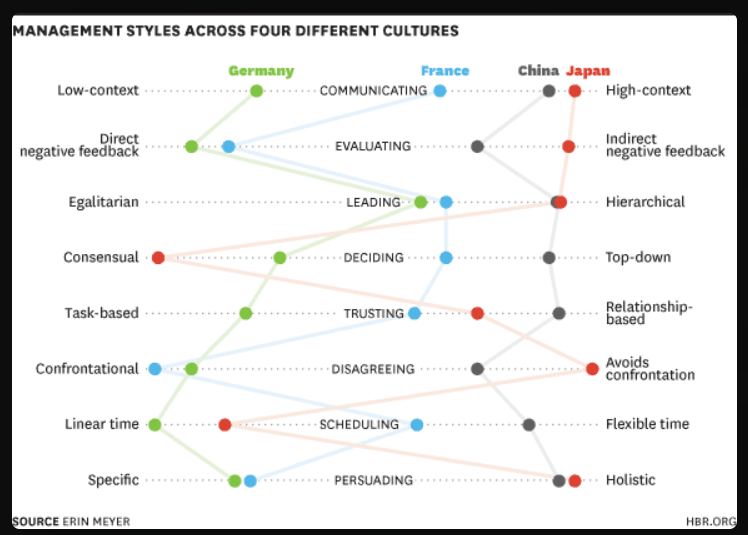
There are eight cultural dimensions (e.g., communication styles, decision-making norms, trust-building) highlighting areas where global teams often clash. Below are the most critical challenges:
| Category | Key Issues | Examples |
|---|---|---|
| Communication Styles | High-context (implicit) vs. low-context (explicit) messaging. | Japanese teams may perceive Dutch directness as rude. |
| Leadership & Hierarchy | Egalitarian (Sweden) vs. hierarchical (Japan) expectations. | Middle Eastern teams defer to senior leaders, clashing with flat Nordic structures. |
| Religious Practices | Conflicting schedules (prayer times, holidays), gender norms. | Ramadan observance disrupts timelines in Muslim-majority countries. |
| Conflict Resolution | Direct confrontation (Israel) vs. harmony preservation (Thailand). | Germans may misinterpret Southeast Asian conflict avoidance. |
| Trust-Building | Task-based (U.S.) vs. relationship-based (China) trust. | Brazilians prioritize personal bonds over contracts. |
| Gender Dynamics | Historical biases (e.g., Japan’s male-dominated leadership until the 1970s). | Female leaders in Japan face skepticism from Middle Eastern peers. |
| Time Perception | Linear (Germany) vs. flexible (India) timelines. | German punctuality vs. Indian “flexible time” causes friction. |
| Decision-Making | Consensus-driven (Sweden) vs. top-down (France). | U.S. teams view Japanese consensus-building as slow. |
| Ethnic Stereotypes | Assumptions about competence or work ethic. | Latin Americans stereotyped as “laid-back”; Asians as “overly technical”. |
| Historical Tensions | Colonial legacies or geopolitical conflicts (e.g., India-Pakistan). | Polish and Russian teams struggle with historical animosity7. |
Regional Stereotypes and Training Priorities
The table below focuses on high-risk regions and their cultural dynamics:
| Region/Country | Key Stereotypes | Cultural Challenges | Training Focus |
|---|---|---|---|
| Japan | Hierarchical, indirect communication. | Resistance to female authority; slow consensus. | Gender sensitivity, agile decision-making133. |
| Middle East | Religious conservatism, strong hierarchy. | Inflexible schedules (prayer times); reluctance to critique seniors. | Religious awareness, egalitarian leadership16. |
| Scandinavia | Egalitarian, non-confrontational. | Perceived as passive; discomfort with assertive feedback. | Constructive disagreement techniques13. |
| Germany | Structured, punctual, direct feedback. | Viewed as rigid; blunt feedback demotivates teams. | Relationship-building, flexible timelines128. |
| Brazil | Relationship-centric, expressive. | Emotional expression misunderstood; seen as unprofessional. | Task-based trust, structured communication14. |
| China | High-context, hierarchical. | Opaque feedback; reluctance to challenge seniors. | Transparent feedback models132. |
| Nigeria | Communal decision-making, respect for seniors. | Indirect communication; perceived as overly deferential. | Direct feedback frameworks19. |
Actionable Recommendations
- Pre-Project Audits: Use Meyer’s Culture Map to identify communication, decision-making, and trust gaps232.
- Targeted Training:
- Hierarchical cultures: Workshops on delegating authority (e.g., Japan, Middle East).
- Egalitarian cultures: Training on navigating hierarchical structures (e.g., Scandinavia)1.
- Religious Sensitivity: Adjust schedules for prayer times/holidays; educate teams on dietary restrictions69.
- Conflict Mediation: Implement “disagree and commit” models to resolve clashes528.
- Gender Inclusion: Address biases via role-playing scenarios (e.g., female leadership in male-dominated regions)1.
Why Certain Groups Need Intensive Training
- Japan/Middle East: Deep-rooted gender/hierarchical norms require unlearning biases.
- U.S./Germany: Direct communication styles risk alienating high-context teams.
- Regions with Historical Tensions (e.g., India-Pakistan): Neutral facilitators and team-building exercises mitigate inherited biases17.
By leveraging Meyer’s framework, global teams can transform cultural friction into innovation catalysts, ensuring alignment with both organizational goals and local sensibilities232.
Here are a few Slides coming out of our projects with Clients, explaining how we work and what you can expect from us.
Tailored solutions that drive success and innovation:
A People’s Journey

Implementing S&OP involves a step-by-step, iterative approach where we learn about existing processes, tools, and identify gaps and challenges.
This journey emphasizes the importance of people, processes, and systems working together to achieve a fully integrated business planning system.
We walk this path together, ensuring continuous improvement and adaptation.
Training

Training is crucial for achieving a common understanding within teams.
Symbiotic collaboration starts with recognizing that S&OP and IBP concepts are supportive tools.
Our training ensures that teams see these processes as enablers of success..
Process Cycle

Our professionally integrated S&OP Cycle serves clearly as the trigger for a call of digitizations needs!
Learn More
Our comprehensive S&OP process cycle integrates unconstraint sales forecasts, demand planning, supply analysis and financial plans to achieve a constraint alignment between all parties involved.
This holistic approach ensures alignment across all departments and regions, fostering collaboration and efficiency.
Process Maturity

We guide organizations through different levels of S&OP/IBP maturity, from basic to advanced stages.
Our expertise helps you implement sophisticated planning processes, leveraging technology and metrics for optimal performance.
Finally, we embrace digital evolution by working with teams that understand their needs and capabilities. This approach allows us to maintain control of the projects and pave the way to excellence.
Demand Analysis

We utilize advanced tools to analyze demand patterns and seasonality, enabling accurate forecasting and strategic planning.
Our insights help you anticipate market changes and adjust your strategies accordingly.
Supply Analysis

Sometimes we need to start “hands-on” and will develop more comfortable digital tools on the way to IBP.
We have developed rough cut capacity planning and optimization tools, to ensure supply chains operates at peak efficiency.
We identify bottlenecks and optimize resources, reducing costs and improving service levels.
Demand Enhancement

Our approach to demand planning addresses constraints and offers tailored solutions to optimize forecasting accuracy and responsiveness.
By analyzing historical data and market trends, we ensure your demand planning is both proactive and precise.
Supply Enhancement

We streamline supply planning by matching capacities with demand across regions.
Our methodology consolidates internal and external capacities, ensuring cost efficiency, quality, and financial considerations.
Supply Planning

Approach: Customized Proposals
We develop tailored supply planning strategies to align capacities with demand across regions, ensuring cost efficiency and timely delivery.
Monthly Cycle

Approach: Customized Proposals
Our S&OP calendar of events streamlines the monthly cycle, integrating sales forecasts, demand planning, and supply analysis for cohesive operations.
Challenges

Detailed information to the board about Status and Challenges:
We provide a comprehensive overview of the current challenges and expectations for the next six months, ensuring transparency and strategic alignment.
Project Plan

Detailed information to the board about Status and Challenges:
Our detailed S&OP/IBP implementation timeline outlines each phase, helping stakeholders understand the project scope and key milestones.
Process Customization

We customize processes to meet your specific requirements, ensuring they are scalable and ready for future digital transformation.