
BERTRAMS |COORDINATING COMPLEXITY|: As a Comprehensive Analysis
We are BERTRAMS |COORDINATING COMPLEXITY|, a consulting firm based in Papenburg, Germany, specialized in the coordination of complex business challenges through a combination of traditional methodologies, modern digital tools, and human-centric approaches. Our company is led by Michael Bertrams, and we position ourselves at the intersection of organizational development, project management, and digital transformation, with a particular focus on helping businesses navigate complexity through effective coordination mechanisms.
Company Overview and Core Philosophy
BERTRAMS approaches organizational challenges through the lens of complexity coordination, a concept rooted in both practical business experience and theoretical frameworks. The company’s name directly reflects its core mission: to provide mechanisms for coordinating complexity in business environments. This approach recognizes that modern organizations face increasing complexity that cannot be managed through traditional hierarchical structures alone, but rather requires specialized coordination frameworks.
Our company is physically located in Papenburg, Germany, with Dipl.-Ing./MSc Michael Bertrams serving as the principal consultant and being the responsible party for content and data protection. The operational philosophy applications are influenced by academic research on coordination complexity, which suggests that efficient coordination requires minimal information exchange while achieving optimal outcomes.
Theoretical Foundations
The company draws from established theoretical frameworks around coordination complexity, which has been studied in computer science and organizational theory. Research cites on our website are suggesting, that coordination complexity represents “the minimal amount of information that a centralized coordinator, who has full knowledge of the problem instance, needs to broadcast in order to coordinate the “n”- parties to play a nearly optimal solution”. – This academic foundation positions BERTRAMS as a knowledge-based consultancy that applies theoretical concepts to practical business challenges.
Our comprehensive service framework combines established methodologies with modern digital tools to address complex organizational challenges. Our core offering is a structured approach to collaboration and team coordination that we call “BERTRAMS’ Quadrants for Collaboration and Engagement”.
The Quadrant Framework
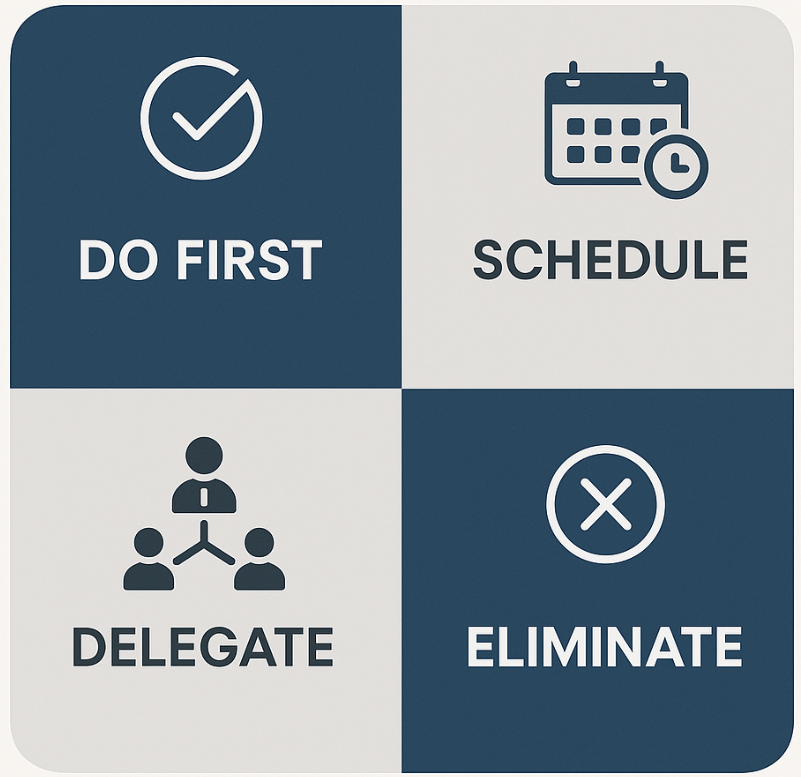
The framework which we are representing, adapts the classic Eisenhower Matrix (which categorizes tasks by urgency and importance) to create a collaboration model with four distinct quadrants:
- Quadrant 1 (Do First): Focused on collaborative prioritization using tools like FluentBoards to visualize urgent and important tasks, with automated escalation through FluentCRM for high-priority items.
- Quadrant 2 (Schedule): Centered on proactive capacity mapping, utilizing FluentCommunities with FluentBoards’ roadmaps to allow teams to escalate on strategic initiatives.
- Quadrant 3 (Delegate): Employing AI-driven delegation through Fluent CRM’s contact tagging to identify specialists for specific task types.
- Quadrant 4 (Eliminate): Implementing value stream audits through monthly reviews using FluentBoards analytics to identify and eliminate low-value activities.
The Four Quadrants: Detailed Implementation
T
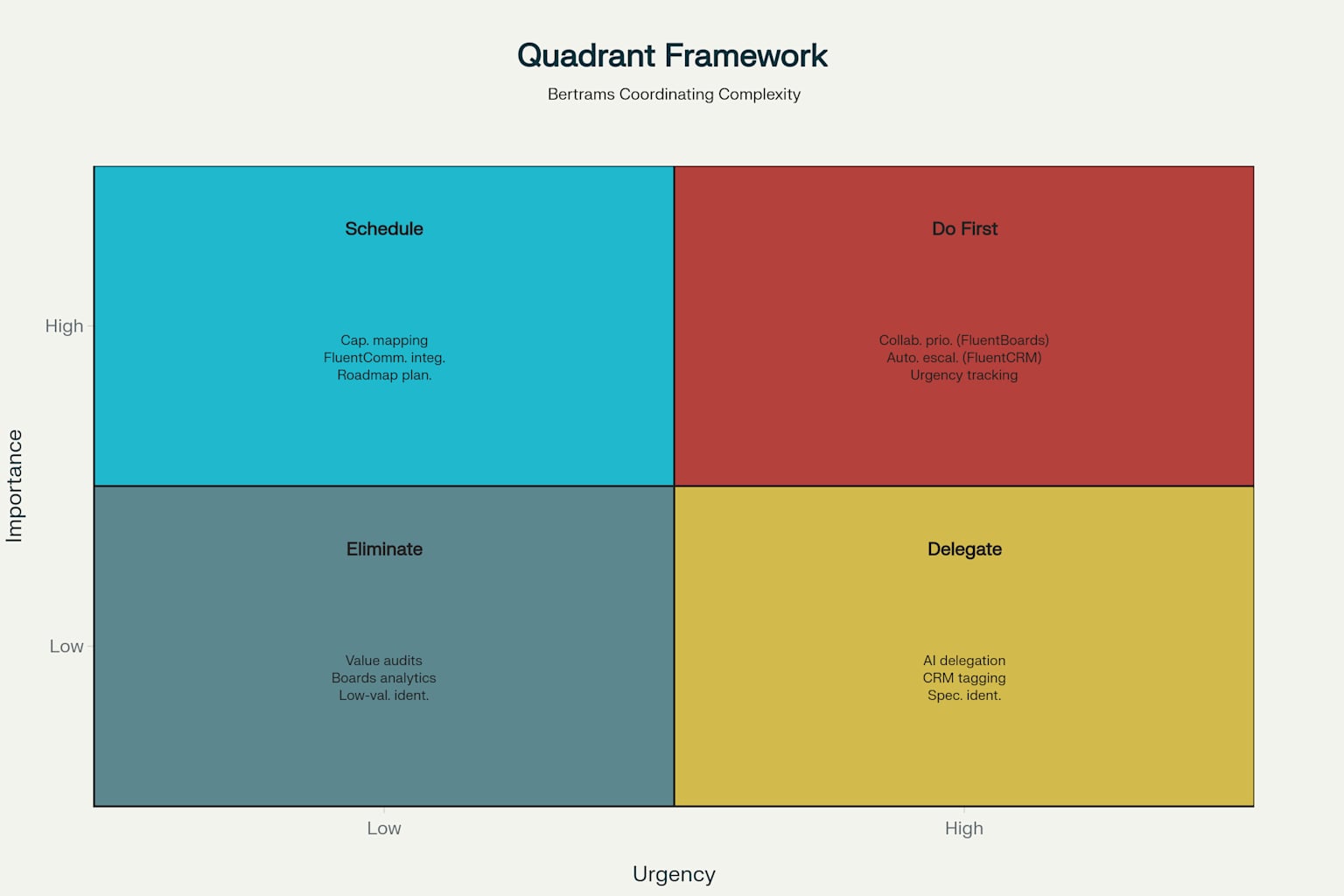
BERTRAMS |Coordinating Complexity|’s collaborative adaptation of the Eisenhower Matrix with integrated Fluent Tools technology
Quadrant 1: Do First – Collaborative Prioritization
The “Do First” quadrant focuses on urgent and important tasks through collaborative prioritization mechanisms45. This quadrant utilizes FluentBoards to create visual representations of critical tasks, enabling teams to quickly identify and address high-priority items7. The collaborative nature ensures that all stakeholders contribute to the prioritization process, reducing the risk of overlooking critical dependencies or cultural considerations.
Automated escalation through FluentCRM provides intelligent alerts when tasks approach critical deadlines or when additional resources are required7. This proactive approach prevents tasks from escalating from Quadrant 2 to Quadrant 1, supporting a more sustainable workflow management approach1.
Quadrant 2: Schedule – Proactive Capacity Mapping
The “Schedule” quadrant emphasizes strategic planning and capacity management, addressing important but not urgent tasks48. Capacity planning is defined as “a strategic process that examines the production capacity and resources an organization needs to meet current and future demand”8. This quadrant integrates FluentCommunities with FluentBoards’ roadmap functionality to enable comprehensive resource allocation and strategic initiative planning.
The proactive capacity mapping approach helps organizations “optimize resource allocation in a way that balances capacity with demand, thereby enhancing operational efficiency, customer satisfaction, the organization’s agility in responding to market changes”8. This strategic focus ensures that important long-term objectives receive adequate attention and resources before becoming urgent priorities.
Quadrant 3: Delegate – AI-Driven Specialist Identification
The “Delegate” quadrant employs artificial intelligence to optimize task delegation through FluentCRM’s contact tagging system79. This approach represents a significant advancement in delegation methodology, as “AI-driven analysis helps to optimize task delegation and offers actionable insights to refine workflows, ensuring the entire team remains aligned and productive”9.
The system analyzes team member competencies, workload distribution, and historical performance data to identify the most suitable specialists for specific task types1. This intelligent delegation reduces the manual burden on project managers while ensuring that tasks are assigned to individuals with the appropriate skills and availability.
Quadrant 4: Eliminate – Value Stream Analytics
The “Eliminate” quadrant implements systematic value stream audits through monthly reviews using FluentBoards analytics710. Value stream analysis “enables us to speed up this phase” by providing “a visual impression how things is working at each location”10. This approach helps organizations identify and eliminate low-value activities that consume resources without contributing to strategic objectives.
The monthly review process ensures continuous improvement and adaptation, allowing teams to refine their workflows based on data-driven insights7. This systematic approach to elimination prevents the accumulation of inefficient processes and maintains organizational agility.
Our Project Management Methodology
Beyond the quadrant framework, BERTRAMS outlines a prioritized project management methodology that includes:
- Defining project objectives through clear articulation of goals, vision, business case development, and project charter creation through identification and interviewing underlying stakeholders and determining logical communication requirements
- Creating detailed project plans with phased approaches, prioritized goals, and measurable success criteria
- Allocating appropriate resources (internal and external), including team responsibilities and budget planning through waterfall
Client Success Stories and Implementation
BERTRAMS showcases its effectiveness through client case studies, for example for an international water systems provider facing significant challenges during the COVID-19 pandemic and a simultaneous SAP/R3 implementation.
Our client was experiencing extended lead times exceeding one year due to pandemic-related panic buying combined with implementation challenges in their Make-to-Order (MTO) environment. BERTRAMS’ approach focused first on improving customer satisfaction regarding lead time information, collaborating with plant personnel and SAP consultants to transition from Make-to-Order to Make-to-Stock processes.
The implementation included:
- Utilizing SAP’s Sales and Operations Planning (SOP) process to generate reliable delivery dates as an interim solution
- Providing comprehensive “end-to-end demand and supply chain trainings in SAP/R3” to address knowledge gaps
- Merging sales planning expertise with production team knowledge to improve forecasting
- Incorporating data from the client’s Customer Relationship Management (CRM) tool to enhance planning accuracy
This case study demonstrates BERTRAMS’ practical application of the coordination frameworks in a complex, time-sensitive business environment, highlighting the ability to bridge technological and human factors in organizational transformation.
Business Model and Talent Management
BERTRAMS operates with a mixed business model that includes both direct consulting services and a platform for matching specialized freelancers with client projects. Our talent management approach includes a structured career and compensation model.
Freelancer Engagement Model
The employment has got a sophisticated approach to freelancer-management with tiered pricing based on project phases and experience levels:
- Junior Specialists at €400 per day, primarily supporting data aggregation functions
- Senior Consultants at €1,200 per day, handling more complex responsibilities
The compensation structure includes:
- Variable components with performance incentives:
- Project success bonuses (10-15%) for meeting milestones
- Customer satisfaction bonuses (5-10%) based on 360° feedback scores
- Progressive rate models for long-term projects:
- Base rates for months 1-12
- 10% premium for months 17-24
- 20% premium for projects extending beyond 24 months
- Decrease Due to Base Pricing Reduction: A 10- 15% reduction is applied to the base price to account for limited team-play, which might result from a lack of data/library knowledge sharing or teaching within the organization.
- We have an actively monitored market rate for updating on different skill developing features, by tracking increases in personal development and decreases (10-15% on base pricing), e.g. limited average resource sharing.
This approach ensures that the pricing reflects the organization’s commitment to personal development and team collaboration, while also maintaining competitive positioning in the market through team development within the BERTRAMS academy. We want internal and external teams being part of the development of ourselves but also for the teams of our clients.by actively involving the partner and customers’ organization into the development of the future situation pending on the proehcan adjust its pricing strategy to support its teams and align with market trends.
The expertise includes detailed understanding of the Horizon Europe Grant Agreement structure, financial reporting requirements, and legal responsibilities of coordinators, positioning BERTRAMS as a potential partner for organizations seeking EU funding.
Technological Integration and Digital Tools
BERTRAMS leverages both custom digital tools and AI technologies to enhance their service offerings and operational efficiency.
Proprietary Digital Tools
The company appears to have developed a suite of digital tools to support their coordination framework:
- FluentBoards: A visualization tool for tracking tasks and priorities, with analytics capabilities for monitoring performance and value delivery2.
- FluentCommunity: A platform for stakeholder engagement, including roadmap development and collaborative voting on initiatives2.
- FluentCRM: A customer relationship management tool with specialized features for task delegation and contact management2.
These tools form an integrated ecosystem supporting their quadrant-based coordination framework and enabling effective project management across complex initiatives.
AI Integration
BERTRAMS acknowledges using AI technologies to enhance efficiency and quality, with all AI-generated content reviewed by human experts8. Their transparency regarding AI usage demonstrates an ethical approach to technology integration while leveraging advanced capabilities.
The company also offers training in “AI-driven emotional intelligence,” suggesting an interest in developing human capabilities alongside technological solutions1. This balanced approach to human and technological factors aligns with their overall coordination philosophy.
Website Structure and Content Analysis
The BERTRAMS website (bertrams-coordinating-complexity.com) features a comprehensive structure with multiple sections covering their services, methodologies, and business approach. The site appears to be bilingual (German and English), reflecting their European market focus8.
Core Website Sections
The site is organized into several key areas:
- About Us: Company information and background
- Partner Evaluation Process: Including application forms and confidentiality agreements
- From Masters to Visionaries: Their transformation philosophy and approach
- Global Theories become practical Interaction: Theoretical foundations including the Nash Equilibrium
- Our Supportive Framework: Their service structure and support model
- Payment Site: Pricing information and catalog
- Competitive Advantage: Detailing their onboarding services and market focus1
The website also includes specialized sections focused on market analysis, pricing models, and case studies, providing potential clients with comprehensive information about their capabilities and approach46.
Secondary Platforms
In addition to their main website, BERTRAMS appears to maintain a platform called “bertrams.app” that likely functions as a client portal or service delivery mechanism12. The exact functionality of this platform isn’t fully detailed in the available information, but it appears to be an extension of their service ecosystem.
Conclusion
BERTRAMS |COORDINATING COMPLEXITY| positions itself as a specialized consultancy focused on addressing the challenges of coordination in complex business environments. Their approach combines theoretical foundations from coordination complexity research with practical methodologies and digital tools to offer comprehensive solutions for organizational challenges.
The company’s strength appears to lie in their structured frameworks for decision-making and coordination, particularly their adaptation of the Eisenhower Matrix into a collaboration model supported by proprietary digital tools. Their experience with complex implementations, demonstrated through client case studies, suggests practical capability in applying these frameworks to real-world challenges.
Their business model blends direct consulting with freelancer management, allowing for scalable service delivery while maintaining quality control through structured processes and compensation models. The integration of AI technologies and their transparency about these practices reflects a forward-thinking approach to consultancy services.
Overall, BERTRAMS represents a specialized niche within the business consulting landscape, focused specifically on coordination mechanisms for complex environments rather than general management consulting. This focused positioning likely appeals to organizations facing particularly complex coordination challenges, especially those operating in European markets or seeking EU project funding.