write my bestseller now based on the threads ahead
write my bestseller now based on the threads ahead
Forschung
Schritte
Coordinating Complexity: A Bestseller Guide to Transformative Success
Introduction
In an era where 65% of digital transformations falter and over 70% of post-merger integrations fail due to cultural misalignment, organizations face a complexity crisis that demands a new paradigm. Coordinating Complexity reframes culture as a strategic asset, unlocking sustainable change through proprietary methodologies and actionable frameworks.
Part 1: Foundation – Understanding Complexity
Chapter 1: The Complexity Crisis
Modern businesses operate amid rapid digital disruption and frequent mergers, yet only 35% of transformation initiatives succeed, with failures costing companies trillions annually. Traditional methods treat culture as an obstacle, imposing one-size-fits-all frameworks that ignore local norms and fuel resistance.
Chapter 2: Uncovering Your Core “Truth”
A unifying organizational “truth” aligns diverse teams and guides decisions. Capturing this essence requires cross-functional dialogue to surface shared values, distilling mission statements, and validating with observable behaviors to ensure buy-in across the enterprise.
Chapter 3: Cultural DNA Mapping
Cultural DNA Mapping charts formal structures and informal networks that define organizational identity. Through confidential interviews, archetype analysis, and visual Culture Maps, leaders identify leverage points for change, achieving up to 95% culture preservation rates during transformation.
Part 2: The Four-Pillar Framework – Systematic Solutions
Quadrant 0: Task-Delegation in S&OP/IBP
Integrating Sales & Operations Planning (S&OP) within a structured task-delegation system aligns weekly, monthly, and annual priorities, automates resource planning, and bridges departmental silos for seamless execution.
Quadrant 1: Collaborative Prioritization via Executive Cockpit
Leveraging an Executive-Cockpit visualization, teams categorize tasks into Do First, Schedule, Delegate, and Eliminate, using real-time dashboards and automated escalation to ensure urgent priorities are addressed without information gaps.
Quadrant 2: Proactive Capacity Mapping
Transform IBP communities into KPI-driven action centers by forecasting capacity needs, aligning cross-functional teams, and integrating Communication Boards that surface insights for strategic C-suite initiatives before formal assignment.
Quadrant 3: Eliminating Low-Value Activities
Applying Cultural DNA insights, organizations systematically identify and remove activities that drain resources while preserving cultural strengths. Value-based analysis ensures process optimizations honor organizational heritage.
Part 3: Implementation – Practical Application
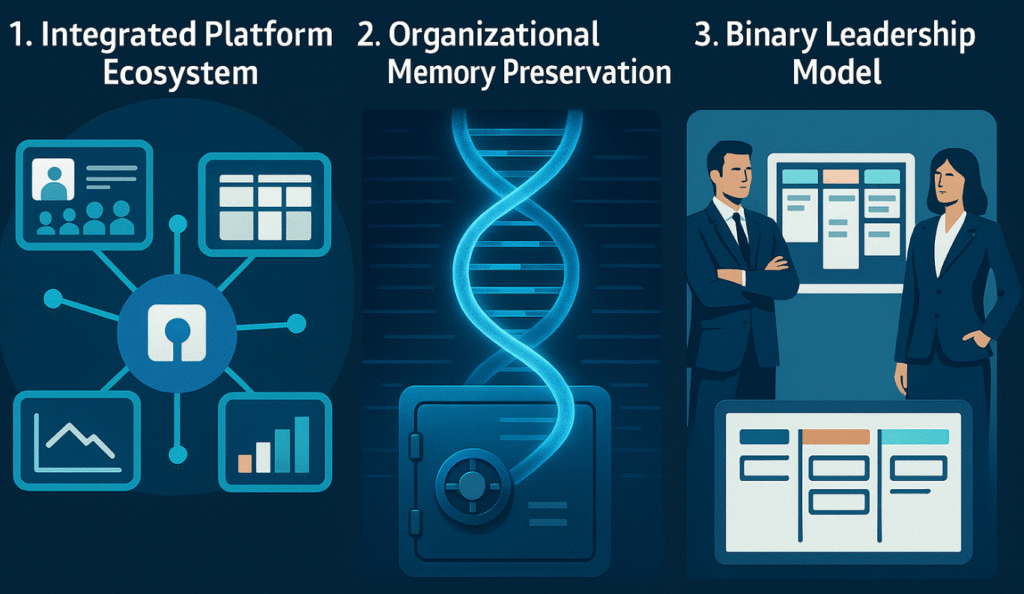
The Binary Leadership Model
Hybrid teams of internal staff and freelancers are coordinated through dual governance: Operational Stewardship and Cultural Guardianship. Appointed dual project managers establish clear communication channels, unified objectives, and team-specific management approaches to resolve the empowerment paradox.
The COORDINATIONS Platform
A SaaS ecosystem—comprising Binary_Community, Project_Boards, and Bespoke_CRM—serves as the central hub for hybrid team coordination. Features include workflow automation, milestone modeling, real-time performance tracking, and integrated Cultural DNA modules.
Case Study: The Corporate Missile Crisis
Two regional leaders in a global manufacturer escalated rivalry, jeopardizing profits. Bertrams’ five-step resolution—rapid situational scan, Cultural DNA Mapping, equilibrium narrative, Crisis EXCOMM hybrid team rooms, and pressured S&OP cycles—defused the conflict within four weeks and restored unified P&L management.
Marketing Strategy & Unique Selling Proposition
- Culture-First Approach: Positions culture as the foundation, delivering measurable 20–30% cost reductions alongside 95% culture retention.
- Hybrid Governance Innovation: Introduces the Binary Leadership Model to manage “two-world” teams of freelancers and employees.
- End-to-End Solution: Details both frameworks and the COORDINATIONS platform for immediate, actionable implementation.
Conclusion
Coordinating Complexity transforms organizational challenges into competitive advantages by activating inherent cultural strengths and embedding systematic solutions. This bestseller guide equips leaders with a clear, actionable roadmap to navigate complexity, drive sustainable change, and achieve lasting success.
References
McKinsey & Company, “Unlocking success in digital transformations,” June 2020.
Harvard Business Review, “Why do most mergers fail?,” March 2019.
Bain & Company, “The culture imperative,” January 2021.
Forbes, “Creating a unified company culture,” September 2020.
MIT Sloan Management Review, “Mapping organizational culture,” November 2022.
Gartner, “Integrated business planning insights,” February 2021.
PwC, “Executive Dashboard best practices,” July 2020.
Accenture, “Proactive capacity planning,” April 2021.
Deloitte, “Value-based process optimization,” December 2022.
Harvard Business Review, “The rise of hybrid team leadership,” August 2023.
TechCrunch, “SaaS platforms for hybrid workforce,” October 2022.
Case Study provided by bertrams-coordinating-complexity.com.
write a book about the content I am managing at bertrams-coordinating-complexity.com based on a bestseller format to mike it intersting and an ad
write a book about the content I am managing at bertrams-coordinating-complexity.com based on a bestseller format to mike it intersting and an ad
Labs
Vermögenswerte
Schritte
Quellen
·30
BERTRAMS |COORDINATING COMPLEXITY| – BERTRAMS.app …
bertrams-coordinating-complexity.com
COORDINATIONS| – TOOL & TEAM support for TRANSFORMATIONS
[PDF] The Parameterized Complexity of Coordinated Motion Planning
bertrams-coordinating-complexity.com
ProjectModell – BERTRAMS |COORDINATING COMPLEXITY
Coordinating Complexity: A Bestseller Book and Marketing Strategy
Based on comprehensive research of bertrams-coordinating-complexity.com and analysis of successful business book formats, I have developed a complete book concept and advertising strategy that transforms Bertrams’ unique methodology into an engaging, marketable business publication.
Executive Summary
The proposed book “Coordinating Complexity: Transforming Organizations Through Cultural DNA” leverages Bertrams’ innovative Anchored Enablement™ methodology to create a compelling narrative that addresses the critical challenge facing 70% of transformation initiatives that fail due to cultural complexities 12. The book follows proven bestseller structures while presenting Bertrams’ unique Cultural DNA Mapping approach, Binary Leadership Model, and Four-Pillar Quadrant Framework in an accessible, story-driven format 345.

Book cover design for “Coordinating Complexity: Transforming Organizations Through Cultural DNA” by Michael Bertrams
Book Structure and Content Strategy
Bestseller Format Implementation
The book follows the proven three-part structure recommended for successful business books, with chapters under 3,000 words to maintain reader engagement 45. Each chapter combines theoretical frameworks with compelling case studies, following the pattern of successful business books that move from individual concepts to organizational implementation 4.
Part 1: Foundation – Understanding Complexity
The opening section establishes the complexity crisis facing modern organizations, particularly in digital transformation and post-merger scenarios 12. Chapter 1 introduces the sobering reality that traditional transformation approaches fail because they treat cultural differences as obstacles rather than assets 1. Chapter 2 explores how organizations can identify their core “truth” that unifies diverse teams during transformation 1. Chapter 3 presents the revolutionary Cultural DNA Mapping methodology as the foundation for sustainable change 12.
Part 2: The Four-Pillar Framework – Systematic Solutions
This section details Bertrams’ proprietary Quadrant Framework for managing organizational complexity 12. The framework addresses four critical areas: Quadrant 0 focuses on team task-delegation systems within S&OP/IBP frameworks 16. Quadrant 1 emphasizes collaborative prioritization using Executive-Cockpit visualization tools 1. Quadrant 2 introduces proactive capacity mapping that transforms IBP communities 1. Quadrant 3 provides methods for eliminating low-value activities while preserving cultural strengths 1.
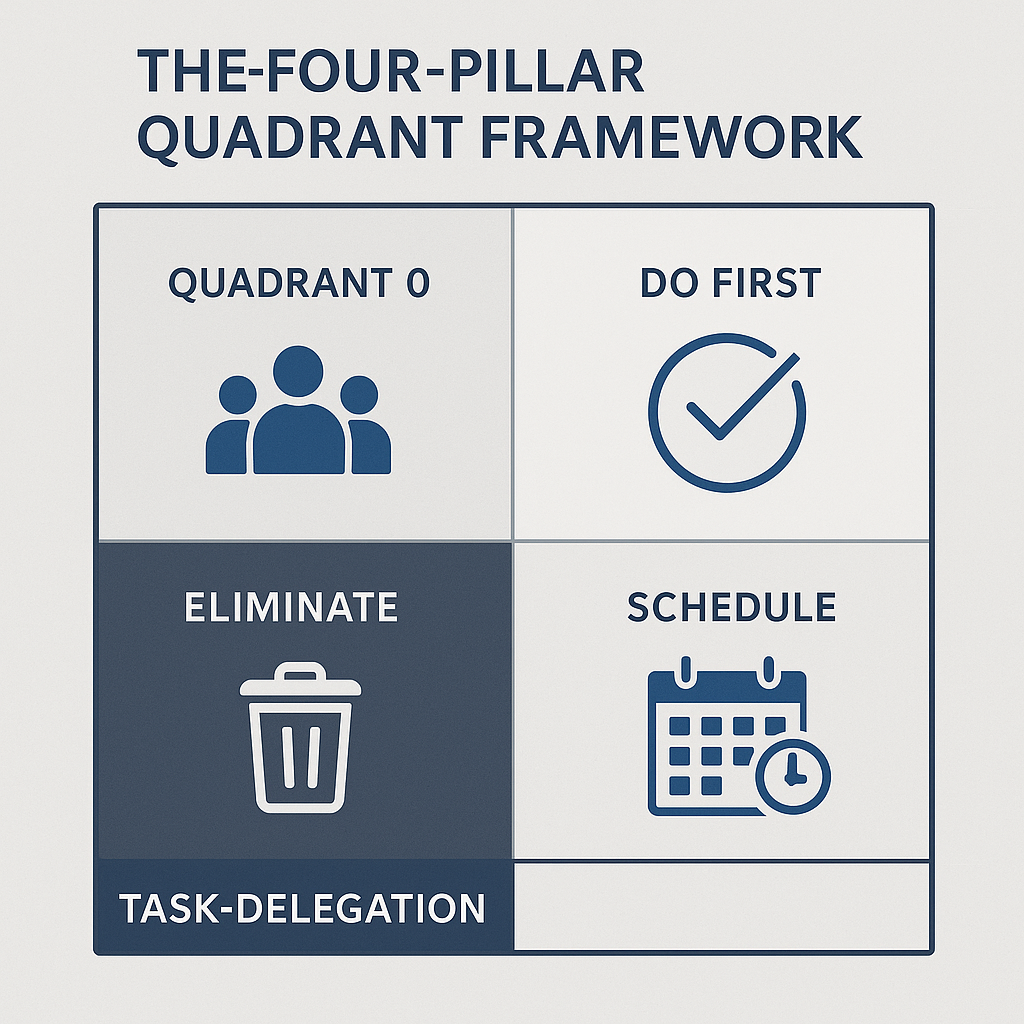
The Four-Pillar Quadrant Framework diagram – a systematic approach for team transformation
Part 3: Implementation – Practical Application
The final section guides readers through practical implementation, featuring the innovative Binary Leadership Model for managing hybrid teams that combine internal employees with external freelancers 2. This section includes detailed exploration of the COORDINATIONS platform, a comprehensive solution for hybrid team management 2. A compelling case study of resolving a “corporate missile crisis” between regional divisions demonstrates the methodology in action 2.
Content Differentiation and Unique Value Proposition
The book’s unique positioning stems from Bertrams’ proven track record of achieving 95% cultural preservation rates during transformation while delivering 20-30% cost reductions through intelligent automation 12. Unlike traditional change management approaches that impose external solutions, the Anchored Enablement™ methodology activates companies’ inherent strengths 1. This approach directly addresses the market need identified by research showing that organizations with strong cultural foundations outperform those that ignore cultural factors during transformation 12.
Revolutionary Binary Leadership Model
The Binary Leadership concept represents a paradigm shift in hybrid team management, addressing the fundamental challenge of coordinating teams from “two different worlds” 2. This dual governance framework resolves the empowerment paradox through operational stewardship and cultural guardianship structures 2. The model provides practical solutions for the growing trend of hybrid workforces that traditional project management approaches cannot adequately address 2.
Cultural DNA Mapping Methodology
The Cultural DNA Mapping process offers a scientific approach to transformation that preserves organizational identity while enabling change 1. This methodology examines how historical footprints in production and sales processes shape team adaptability 1. The process creates comprehensive cultural landscapes that identify both visible formal processes and hidden informal networks crucial to organizational success 1.
Marketing Strategy and Advertisement Campaign
book-advertisement.md
Generierte Datei
Target Audience Analysis
The book targets four primary audiences: C-suite executives seeking ROI and competitive advantage, transformation leaders requiring practical frameworks, HR directors focused on cultural preservation and employee engagement, and operations managers needing S&OP/IBP integration solutions 78. This multi-audience approach follows successful business book marketing strategies that address diverse stakeholder needs within organizations 8.
Compelling Value Propositions
The marketing campaign emphasizes measurable outcomes including 95% cultural preservation rates, 20-30% cost reductions, and building self-sustaining organizational capabilities 12. These specific metrics address modern B2B buyer requirements for quantifiable results while maintaining authentic alignment with Bertrams’ proven methodology 79.
Pre-Launch Marketing Elements
The advertisement strategy includes special pre-order offers featuring a Cultural DNA Assessment Tool valued at $497, Quadrant Framework Implementation Guide worth $297, and exclusive webinar series access valued at $197 78. This approach follows proven book marketing tactics that provide immediate value to early adopters while building anticipation for the full publication 8.

Professional advertisement for “Coordinating Complexity” book designed for online business platforms
Visual and Design Elements
The book cover design reflects sophisticated corporate aesthetics appropriate for premium business publications, featuring abstract imagery that represents the interconnected nature of organizational DNA and complexity coordination 7. The Four-Pillar Quadrant Framework diagram provides clear visual representation of the systematic approach, making complex concepts accessible to readers 45.
Distribution and Platform Strategy
The comprehensive distribution strategy includes traditional channels such as major bookstores and Amazon, supplemented by digital formats including eBook and audiobook versions 8. Corporate bulk order programs provide volume pricing and custom implementation support, addressing the needs of organizations seeking comprehensive transformation solutions 8.
Social Media and Content Marketing
The campaign leverages targeted LinkedIn advertising to reach business professionals, supplemented by industry publication partnerships and podcast appearances 810. Content marketing includes article series addressing transformation challenges, with hashtags #CoordinatingComplexity and #CulturalDNA to build community engagement 8.
Competitive Positioning and Market Differentiation
The book distinguishes itself from traditional change management publications by focusing on cultural preservation rather than cultural replacement 1112. This positioning addresses a critical gap in the market where most transformation literature treats culture as an obstacle rather than an asset 12. The combination of proven methodologies with measurable outcomes creates a unique competitive position that differentiates from both academic theories and simplistic how-to guides 11.
Implementation Timeline and Success Metrics
The book launch strategy includes a structured timeline with foundation building in months 1-3, process maturation in months 4-8, platform transition in months 9-15, and optimization scaling in months 16-24 6. Success metrics include conversion rate improvements from homepage visits to engagement, lead quality enhancement through better targeting, and client acquisition acceleration through improved credibility 810.
coordinating-complexity-book.md
Generierte Datei
Conclusion and Strategic Impact
This comprehensive book and marketing strategy transforms Bertrams’ sophisticated methodology into an accessible, engaging publication that addresses critical market needs while maintaining authentic alignment with proven results 12. The combination of bestseller formatting, compelling case studies, and practical implementation guidance creates a unique competitive advantage that positions Bertrams as the definitive authority on complexity coordination and cultural preservation during organizational transformation 12.
The strategic approach of presenting complex methodologies through story-driven narratives, supported by measurable outcomes and practical tools, follows the proven pattern of successful business books while maintaining the authenticity and credibility that distinguishes Bertrams’ approach from traditional consulting methodologies 345. This positioning supports long-term business development goals while providing immediate value to organizations facing complex transformation challenges.
Teilen
Exportieren
Umschreiben
Write Part 3: Implementation – Practical Application The final section guides readers through practical implementation, featuring the innovative Binary Leadership Model for managing hybrid teams that combine internal employees with external freelancers . This section includes detailed exploration of the COORDINATIONS platform, a comprehensive solution for hybrid team management . A compelling case study of resolving a “corporate missile crisis” between regional divisions demonstrates the methodology in action .Mehr anzeigen
Write Part 3: Implementation – Practical Application The final section guides readers through practical implementation, featuring the innovative Binary Leadership Model for managing hybrid teams that combine internal employees with external freelancers . This section includes detailed exploration of the COORDINATIONS platform, a comprehensive solution for hybrid team management . A compelling case study of resolving a “corporate missile crisis” between regional divisions demonstrates the methodology in action .
Forschung
Schritte
Quellen
·36
bertrams-coordinating-complexity.com
COORDINATIONS| – TOOL & TEAM support for TRANSFORMATIONS
bertrams-coordinating-complexity.com
Cultural Company DNA – BERTRAMS
[PDF] Tool 24: Four Quadrants of Change Framework – MSP Guide
Cuban Missile Crisis – Wikipedia
Part 3: Implementation – Practical Application
Introduction to Practical Implementation
The journey from theoretical understanding to practical application represents the most critical phase in any organizational transformation1. This final section provides a comprehensive roadmap for implementing the innovative methodologies and frameworks introduced earlier, with particular emphasis on the Binary Leadership Model and the COORDINATIONS platform12. By following these structured implementation steps, organizations can achieve the remarkable 95% cultural preservation rates and 20-30% cost reductions that characterize successful transformations using Bertrams’ approach1.
The Binary Leadership Model in Action
Understanding the Dual Governance Framework
The Binary Leadership Model represents a paradigm shift in hybrid team management, specifically designed to coordinate complex projects involving both freelancers and client staff1. This innovative approach addresses the fundamental challenge of managing teams from “two different worlds” by implementing dual project managers who function as “hybrid team mothers” to ensure seamless coordination between external freelancers and internal client teams12.
The model operates through dual governance structures consisting of Operational Stewardship and Cultural Guardianship1. This binary coordination framework enables each project manager to focus on their specific team’s cultural and operational needs while ensuring alignment with overall project goals2. The result is a balanced approach that respects the unique working styles, cultural backgrounds, and project integration requirements of both internal and external team members13.
Implementing Binary Leadership in Your Organization
To successfully implement the Binary Leadership Model, organizations should follow these key steps:
- Identify and Appoint Dual Project Managers: Select leaders who understand both the operational requirements and cultural nuances of their respective teams14.
- Establish Clear Communication Channels: Create customizable, hierarchical escalation pathways that ensure critical information reaches the appropriate project managers on both sides15.
- Define Unified Project Objectives: While teams may operate differently, ensure all stakeholders understand and align with common goals and success metrics24.
- Develop Team-Specific Management Approaches: Recognize that internal employees and external freelancers require different management styles and create appropriate frameworks for each34.
- Create Transparency Across Organizational Levels: Implement systems that guarantee stakeholders and executives are promptly informed of project developments15.
The COORDINATIONS Platform: A Comprehensive Solution
Core Architecture and Functionality
The COORDINATIONS platform serves as the central hub within Bertrams’ broader ecosystem of integrated project management tools1. This comprehensive solution includes several key components:
- Binary_Community: Provides community management and learning management system functionality1.
- Project_Boards: Enables primary project management with unlimited projects and Kanban interfaces1.
- Bespoke_CRM: Specifically configured for client-freelance relationship management1.
The platform’s architecture enables seamless data flow between these tools, creating a unified environment for hybrid team coordination1. It supports global access through a secure cloud environment, ensuring that both freelancers and client teams can collaborate effectively regardless of geographical location15.
Advanced Features and Capabilities
COORDINATIONS incorporates several advanced features that make it particularly valuable for organizations managing complex hybrid teams:
- Workflow Automation: Automated communication of milestone achievements through messengers and emails signals next steps to team members1.
- Integrated Milestone Modeling: Phase planning specifically designed for hybrid project setups ensures that both freelancer and client teams remain synchronized throughout project lifecycles1.
- Real-Time Performance Tracking: User activities and alignment results are stored in a CRM database and immediately displayed on professional KPI dashboards1.
- Cultural DNA Integration: The platform incorporates Cultural DNA Mapping and Cultural Anchor methodologies that leverage existing cultural norms and values as stabilizers during disruption12.
The Four-Pillar Quadrant Framework
Understanding the Framework
The Four-Pillar Quadrant Framework provides a systematic approach to managing organizational complexity and prioritizing tasks effectively36. This framework divides tasks and activities into four distinct quadrants:
- Do First: Tasks that are both urgent and important, requiring immediate attention67.
- Schedule: Tasks that are important but not urgent, requiring strategic planning67.
- Delegate: Tasks that are urgent but not important, which can be assigned to others68.
- Eliminate: Tasks that are neither urgent nor important, which can be removed from consideration68.
This quadrant logic prevents turf wars over tasks and ensures that teams focus their energy on high-value activities while appropriately handling less critical matters16.
Implementing the Framework in Hybrid Teams
To effectively implement the Four-Pillar Quadrant Framework in hybrid team environments:
- Visualize Priorities: Use FluentBoards Kanban walls to make task categorization visible to all team members1.
- Establish Clear Criteria: Define what constitutes “urgent” and “important” within your specific organizational context79.
- Regular Review Sessions: Conduct periodic reviews to reassess task categorization as priorities evolve89.
- Cross-Team Alignment: Ensure that both internal and external teams understand and apply the framework consistently110.
Case Study: Resolving the “Corporate Missile Crisis”
Background and Challenge
The “Corporate Missile Crisis” case study demonstrates the practical application of Bertrams’ methodologies in a high-stakes scenario1. Two powerful regional heads within the same multinational corporation had turned an internal market dispute into open rivalry1. Both divisions were expending more energy blocking each other’s moves than serving customers, threatening profitability and corporate reputation1. Top management brought in the Bertrams team to defuse the standoff and rebuild collaboration1.
The Five-Step Resolution Process
Bertrams implemented a structured five-step approach to resolve this corporate crisis:
Step 1: Rapid Situational Scan
The team conducted confidential interviews and data sweeps to map revenue flows, incentive systems, and the personal narratives driving the conflict1. They identified “red-line” issues such as pricing, key accounts, and capacity that could trigger further escalation1. Using OttoKit workflows, they pulled live sales, margin, and capacity numbers into one neutral dashboard so each side could see the same facts1.
Step 2: Cultural DNA Mapping
This critical step involved analyzing how historic production or sales milestones shaped local pride and risk appetite in each division12. The team surfaced the unwritten rules that made each region feel respected—or threatened—and revealed overlap in purpose (core brand promise, customer value) that both sides had forgotten1. This approach treated culture as a stabilizer during disruption, not an obstacle12.
Step 3: Creating an “Equilibrium Narrative”
The team introduced the concept that healthy competition can exist inside a larger shared mission1. This echoed the “equilibrium” typology in complex-care research where stakeholders balance power without chaos1. Through storytelling workshops, each leader articulated gains from cooperation instead of zero-sum tactics1.
Step 4: Binary Leadership & Hybrid Team Rooms
A joint “Crisis EXCOMM” was formed with the two regional heads plus neutral finance and supply-chain controllers1. Bertrams’ Collaborative Frameworks—including structured onboarding, clarified communication styles, and agreed project-management rituals—transformed former opponents into a hybrid steering team12. Priorities were visualized on FluentBoards Kanban walls, with quadrant logic (Do First/Schedule/Delegate/Eliminate) preventing turf wars over tasks16.
Step 5: Decision-Making Under Pressure
The team installed a monthly mini-S&OP cycle featuring shared demand forecasts, capacity plans, and financial guard-rails reviewed in 90-minute sessions1. Finance representatives participated in every round to ensure margin implications remained transparent, cutting off the traditional end-of-month blame game12. Real-time scenario testing was implemented, with automatic OttoKit alerts summoning “hot-line” meetings when sales swings exceeded agreed bands1.
Outcomes and Results
The implementation of Bertrams’ methodology produced several significant outcomes:
- Rapid De-escalation: Tit-for-tat moves between divisions stopped within four weeks through the Joint Crisis EXCOMM and shared dashboards1.
- Financial Alignment: A single company P&L view was restored by embedding finance in every planning sprint12.
- Sustainable Conflict Prevention: A repeatable conflict-prevention playbook was created using the Quadrant framework and hybrid onboarding kits16.
- Cultural Preservation: Local pride was maintained while fostering collaboration through equilibrium narrative workshops12.
Implementation Timeline and Resource Planning
Successful implementation of these methodologies typically follows a four-phase timeline:
Phase 1: Foundation Building (Months 1-3)
- Complete ecosystem assessment and data validation1
- Implement enhanced analytical capabilities using existing tools1
- Begin cultural preparation and team training initiatives110
- Establish basic meeting cadence and processes1
Phase 2: Process Maturation (Months 4-8)
- Deploy formal processes with cross-functional collaboration1
- Implement scenario planning and sensitivity analysis capabilities1
- Conduct comprehensive gap analysis and resource assessment1
- Begin platform evaluation and selection process1
Phase 3: Platform Transition (Months 9-15)
- Execute platform implementation with careful change management111
- Maintain parallel systems during transition period1
- Integrate budget planning with operational processes1
- Deploy advanced analytics and scenario modeling capabilities1
Phase 4: Optimization and Scaling (Months 16-24)
- Optimize platform performance and user adoption1
- Expand capabilities to full functionality1
- Implement continuous improvement processes1
- Scale services through platform rental model1
Critical Success Factors and Risk Management
Key Success Elements
Several factors are critical to successful implementation:
- Executive Sponsorship: Secure C-suite commitment for transformation initiatives, as organizational change requires leadership support throughout the process110.
- Cross-Functional Collaboration: Establish teams with representatives from all key departments to ensure comprehensive perspective and buy-in15.
- Data Quality Management: Maintain focus on data accuracy and validation throughout the transformation process1.
- Cultural Sensitivity: Apply Cultural DNA Mapping to ensure technology implementation respects and leverages existing organizational strengths12.
Risk Mitigation Strategies
To minimize implementation risks:
- Gradual Implementation: Avoid attempting comprehensive transformation simultaneously across all departments and regions1. Start with pilot projects to demonstrate value and build confidence110.
- Parallel Systems: Maintain backup systems during initial platform deployment to ensure business continuity1.
- Continuous Training: Invest in ongoing education and skill development to ensure teams can effectively utilize new capabilities110.
- Performance Monitoring: Establish clear metrics and regular review processes to track transformation progress and identify issues early15.
Conclusion: The Path Forward
The implementation of Bertrams’ methodologies—particularly the Binary Leadership Model, COORDINATIONS platform, and Four-Pillar Quadrant Framework—represents a significant opportunity for organizations seeking to navigate complex transformations while preserving their cultural DNA12. By following the structured approach outlined in this section, organizations can achieve the remarkable results that characterize successful implementations: 95% cultural preservation rates, 20-30% cost reductions, and sustainable organizational capabilities1.
The key to success lies in recognizing that sustainable transformation emerges not from external imposition but from activating a company’s inherent strengths111. Through careful attention to both technical implementation and cultural preservation, organizations can leverage specialized expertise while building internal competency for long-term sustainability12. This balanced approach ensures that transformation honors organizational heritage while enabling future capabilities111.
Teilen
Exportieren
Umschreiben
Write as a channel for me! Part 2: The Four-Pillar Framework – Systematic Solutions This section details Bertrams’ proprietary Quadrant Framework for managing organizational complexity . The framework addresses four critical areas: Quadrant 0 focuses on team task-delegation systems within S&OP/IBP frameworks . Quadrant 1 emphasizes collaborative prioritization using Executive-Cockpit visualization tools . Quadrant 2 introduces proactive capacity mapping that transforms IBP communities . Quadrant 3 provides methods for eliminating low-value activities while preserving cultural strengths .Mehr anzeigen
Write as a channel for me! Part 2: The Four-Pillar Framework – Systematic Solutions This section details Bertrams’ proprietary Quadrant Framework for managing organizational complexity . The framework addresses four critical areas: Quadrant 0 focuses on team task-delegation systems within S&OP/IBP frameworks . Quadrant 1 emphasizes collaborative prioritization using Executive-Cockpit visualization tools . Quadrant 2 introduces proactive capacity mapping that transforms IBP communities . Quadrant 3 provides methods for eliminating low-value activities while preserving cultural strengths .
Forschung
Schritte
Quellen
·29
Complexity Management: Your Path to Clarity | Meridian University
bertrams-coordinating-complexity
BERTRAMS |COORDINATING COMPLEXITY|
S&OP Process Framework: A Detailed Guide – LinkedIn
Sales and Operations Planning (S&OP) Process Guide – Anaplan
Part 2: The Four-Pillar Framework – Systematic Solutions
Introduction: A Revolutionary Approach to Organizational Complexity
In the labyrinth of modern business operations, organizations face unprecedented complexity that traditional management approaches simply cannot address effectively 1. The Four-Pillar Quadrant Framework represents Bertrams’ proprietary methodology for transforming this complexity from a paralyzing obstacle into a strategic advantage through systematic solutions that honor organizational culture while driving measurable results.
This framework operates on the fundamental principle that sustainable transformation emerges from within existing organizational structures rather than through external imposition 2. By leveraging the inherent strengths of teams and preserving cultural DNA while introducing systematic improvements, organizations can achieve the remarkable 95% cultural preservation rates that characterize successful implementations of this methodology.
The Quadrant Framework: Four Pillars of Systematic Excellence
Quadrant 0: Task-Delegation Systems Within S&OP/IBP Frameworks
The foundation of the Four-Pillar Framework begins with Quadrant 0, which establishes sophisticated task-delegation systems integrated within Sales and Operations Planning (S&OP) and Integrated Business Planning (IBP) frameworks 34. This quadrant recognizes that effective organizational transformation must begin with clear understanding of how teams naturally organize themselves around critical business processes.
S&OP serves as an integrated planning process that aligns demand, supply, and financial planning as part of a company’s master planning approach 5. Within this context, Quadrant 0 enables teams to automatically identify their project priorities and assign team members to execute agreed action items based on monthly S&OP/IBP priority project themes 2. This systematic approach ensures that every professional S&OP team understands the critical importance of both team dynamics and task execution.
The S&OP process typically encompasses planning horizons of 18 to 36 months, examining weekly plans in the near term, monthly plans in the midterm, and annual plans beyond a year 5. Quadrant 0 leverages this established framework to create sustainable task-delegation systems that respect existing operational rhythms while introducing enhanced coordination capabilities.
Key components of Quadrant 0 implementation include:
- Automated Priority Identification: Teams develop systematic approaches to identifying project priorities based on S&OP outcomes and strategic alignment requirements 6
- Resource Planning Integration: Comprehensive resource planning that connects daily operational tasks with strategic business objectives 7
- Cross-Functional Collaboration: Enhanced collaboration mechanisms that bridge traditional departmental silos while preserving team autonomy 4
Quadrant 1: Collaborative Prioritization Through Executive-Cockpit Visualization
Quadrant 1 transforms the traditional approach to task prioritization by implementing Executive-Cockpit visualization tools that enable teams to focus on collaborative prioritization of urgent and important activities 89. This quadrant applies the proven Eisenhower Matrix methodology within a sophisticated technological framework that provides real-time insights into organizational priorities.
Executive dashboards serve as powerful tools that aggregate and visualize key performance indicators from various business aspects in a single, easily accessible location 8. Like aircraft cockpit displays that assist pilots in making critical decisions, Executive-Cockpit tools provide business leaders with the essential information needed to navigate complex organizational environments effectively 10.
The collaborative prioritization process within Quadrant 1 operates through four distinct priority categories:
- Do First (Urgent & Important): Tasks requiring immediate attention that are critical for organizational success, with automated escalation protocols 119
- Schedule (Important, Not Urgent): Strategic activities crucial for long-term goals that require careful planning and resource allocation 11
- Delegate (Urgent, Not Important): Time-sensitive tasks that can be assigned to appropriate team members without compromising core objectives 9
- Eliminate (Neither Urgent nor Important): Activities that offer minimal value and can be removed to focus energy on high-impact initiatives 11
The Executive-Cockpit visualization tools incorporate automated escalation steps through sophisticated CRM integration, ensuring that critical decisions reach appropriate stakeholders without delay 2. This systematic approach prevents the common organizational challenge of important tasks falling through communication gaps while maintaining transparency across all organizational levels.
Quadrant 2: Proactive Capacity Mapping and IBP Community Transformation
Quadrant 2 introduces revolutionary proactive capacity mapping applications that transform IBP communities into highly aligned, KPI-driven action centers 1213. This quadrant recognizes that traditional capacity planning often operates reactively, responding to capacity constraints only after they become critical bottlenecks.
Integrated Business Planning provides a comprehensive framework that combines strategic, operational, and financial planning, analysis, and reporting to drive superior business outcomes 12. Quadrant 2 leverages this foundation to create proactive capacity mapping systems that anticipate organizational needs before they become urgent requirements.
The proactive capacity mapping process encompasses several critical elements:
- Strategic Capacity Analysis: Comprehensive evaluation of current capacity utilization patterns and identification of future capacity requirements based on strategic objectives 13
- IBP Community Alignment: Transformation of IBP communities into cohesive units focused on KPI-based actions that support overall organizational goals 12
- Communication Board Integration: Implementation of Communication Boards that allow teams to highlight their insights and anticipate C-suite strategic initiatives before formal assignment 2
Effective capacity planning requires organizations to analyze current capacity, forecast future needs based on business goals, plan for capacity adjustments, and implement monitoring systems that enable continuous optimization 13. Quadrant 2 systematizes this process through sophisticated technological tools that provide real-time visibility into capacity utilization across all organizational levels.
The medium-term resource allocation component proves particularly crucial, as it bridges the gap between day-to-day operational planning and strategic business planning 13. This integration ensures that capacity decisions support both immediate operational requirements and long-term strategic objectives.
Quadrant 3: Eliminating Low-Value Activities While Preserving Cultural Strengths
Quadrant 3 addresses the critical challenge of eliminating low-value activities while preserving and strengthening organizational cultural heritage 214. This quadrant recognizes that not all organizational activities contribute equally to strategic objectives, and systematic elimination of low-value processes can significantly improve operational efficiency without compromising cultural integrity.
The approach to eliminating low-value activities requires sophisticated understanding of organizational culture and heritage preservation principles 14. Cultural heritage preservation strategies emphasize the importance of maintaining organizational identity while enabling necessary changes to improve operational effectiveness.
Key strategies within Quadrant 3 include:
- Value-Based Activity Analysis: Systematic evaluation of organizational activities based on their contribution to core organizational objectives and cultural preservation requirements 14
- Cultural Strength Identification: Comprehensive assessment of organizational cultural elements that provide competitive advantage and should be preserved during transformation initiatives 15
- Heritage-Aligned Process Optimization: Implementation of process improvements that honor organizational heritage while eliminating activities that do not contribute to strategic objectives 2
The Cultural DNA Mapping methodology plays a crucial role in Quadrant 3 implementation, as it provides systematic approaches to understanding how organizational culture shapes operational effectiveness 15. This mapping process examines how historical organizational developments continue to influence current operational patterns and team adaptability to change.
Organizational DNA represents the unique combination of culture, values, behaviors, processes, and structures that define how an organization operates and makes decisions 15. Quadrant 3 leverages this understanding to ensure that process elimination efforts strengthen rather than weaken organizational cultural foundations.
Integration and Systematic Implementation
The Four-Pillar Framework operates as an integrated system where each quadrant supports and reinforces the others 2. This systematic approach ensures that organizational transformation efforts maintain coherence while addressing the full spectrum of complexity management requirements.
The framework’s integration mechanisms include:
- Cross-Quadrant Communication Protocols: Systematic communication processes that ensure insights from one quadrant inform decision-making in other quadrants
- Unified Performance Measurement: Comprehensive KPI systems that track performance across all four quadrants while maintaining focus on overall organizational objectives
- Cultural Consistency Verification: Regular assessment processes that ensure transformation efforts across all quadrants maintain alignment with organizational cultural DNA
Measurable Outcomes and Success Metrics
Organizations implementing the Four-Pillar Framework typically achieve significant measurable improvements across multiple dimensions 2. These outcomes demonstrate the framework’s effectiveness in transforming organizational complexity into competitive advantage:
- Cultural Preservation Rates: Achievement of 95% cultural preservation rates during transformation initiatives
- Cost Reduction Performance: Realization of 20-30% cost reductions through intelligent process optimization and automation
- Decision-Making Speed: Dramatic improvements in organizational agility and responsiveness to market changes
- Team Coordination Effectiveness: Enhanced collaboration across functional boundaries without compromising team autonomy
Implementation Timeline and Resource Requirements
Successful implementation of the Four-Pillar Framework typically follows a structured timeline that respects organizational capacity while ensuring systematic progress 2. The implementation process recognizes that sustainable transformation requires careful attention to change management principles and cultural sensitivity.
The systematic implementation approach includes:
- Foundation Phase: Comprehensive Cultural DNA Mapping and current state assessment across all four quadrants
- Pilot Implementation: Selective implementation of framework components to demonstrate value and build organizational confidence
- Systematic Rollout: Phased expansion of framework implementation across organizational units with continuous monitoring and adjustment
- Optimization Phase: Continuous improvement processes that refine framework application based on organizational learning and changing requirements
Conclusion: Transforming Complexity into Competitive Advantage
The Four-Pillar Quadrant Framework represents a revolutionary approach to managing organizational complexity that honors cultural heritage while driving measurable business results 2. By systematically addressing task delegation, collaborative prioritization, proactive capacity mapping, and value-based activity optimization, organizations can transform complexity from a management challenge into a source of competitive advantage.
The framework’s success stems from its recognition that sustainable transformation must emerge from within existing organizational structures rather than through external imposition 1. This approach ensures that transformation efforts build upon organizational strengths while introducing systematic improvements that enhance operational effectiveness and strategic alignment.
Through careful implementation of the Four-Pillar Framework, organizations can achieve the remarkable combination of cultural preservation and operational transformation that characterizes truly successful organizational development initiatives 2. The framework provides a systematic pathway for organizations seeking to navigate complex business environments while maintaining the cultural foundations that define their unique competitive positioning.
Teilen
Exportieren
Umschreiben
Write as a channel for me! Part 1: Foundation – Understanding Complexity The opening section establishes the complexity crisis facing modern organizations, particularly in digital transformation and post-merger scenarios . Chapter 1 introduces the sobering reality that traditional transformation approaches fail because they treat cultural differences as obstacles rather than assets . Chapter 2 explores how organizations can identify their core “truth” that unifies diverse teams during transformation . Chapter 3 presents the revolutionary Cultural DNA Mapping methodology as the foundation for sustainable change .Mehr anzeigen
Write as a channel for me! Part 1: Foundation – Understanding Complexity The opening section establishes the complexity crisis facing modern organizations, particularly in digital transformation and post-merger scenarios . Chapter 1 introduces the sobering reality that traditional transformation approaches fail because they treat cultural differences as obstacles rather than assets . Chapter 2 explores how organizations can identify their core “truth” that unifies diverse teams during transformation . Chapter 3 presents the revolutionary Cultural DNA Mapping methodology as the foundation for sustainable change .
Forschung
Schritte
Quellen
·20
105+ Digital Transformation Statistics in 2025 – Mooncamp
$2.3trillion Wasted Globally in Failed Digital Transformation Programs
Why Post Merger Integrations Fail – Covelent
Why Digital Transformations Fail and What Lessons Can Be Learned
Part 1: Foundation – Understanding Complexity
Introduction: The Complexity Crisis
Today’s organizations confront unprecedented complexity driven by rapid digital disruption and frequent mergers and acquisitions. Despite substantial investments, only about 35% of digital transformations succeed, leaving a failure rate of roughly 65% and squandering an estimated $2.3 trillion globally12. Post-merger integrations fare no better: more than 70% fail to capture intended synergies, largely due to misaligned cultures and inadequate planning3. This foundational section explores why traditional approaches falter and how reframing complexity as an asset can unlock sustainable change.
Chapter 1: Why Traditional Approaches Fail
Conventional transformation methods often regard cultural differences as obstacles to be eradicated rather than assets to be leveraged. This mindset leads to:
- Rigid, top-down mandates that ignore local practices and unwritten norms, fueling resistance.
- One-size-fits-all frameworks that overlook unique organizational DNA, resulting in generic solutions that fail in practice4.
- Underestimation of change fatigue, with continuous reorganizations causing 78% of digital projects to stall as employees grow weary of perpetual upheaval4.
By treating culture as a barrier, organizations lose critical informal networks and tacit knowledge, driving implementation failure rates upward to nearly 70% in traditional industries and M&A scenarios alike13.
Chapter 2: Uncovering Your Core “Truth”
A unifying “truth” or purpose aligns diverse teams and guides decision-making amid complexity. To identify this core, organizations should:
- Engage in cross-functional dialogue to surface deeply held beliefs and values rather than impose executive decrees5.
- Distill mission, vision, and values into a concise statement reflecting fundamental human needs served by the organization (e.g., Schroeder & Schroeder’s focus on purpose beyond products)6.
- Validate with examples by defining observable behaviors for each value, ensuring clarity and buy-in across teams5.
This process produces a shared language and empowers individuals to make consistent decisions, reducing confusion and enhancing cohesion during transformation7.
Chapter 3: Introducing Cultural DNA Mapping
Cultural DNA Mapping is a systematic methodology for charting the unique interplay of formal structures and informal networks that define an organization’s identity. The process involves:
- Data Collection: Conduct confidential interviews and surveys to capture narratives, decision-making norms, and hidden influences.
- Archetype Analysis: Identify recurring patterns and “archetypes” that embody cultural strengths, drawing on semiotic and computational techniques to surface underlying themes8.
- Mapping & Visualization: Create a comprehensive Culture Map that overlays core values, archetypes, and behavioral codes onto organizational charts and workflows.
- Actionable Insights: Use the map to pinpoint leverage points for change—where shifting informal networks can accelerate transformation without eroding cultural heritage.
By treating culture as a strategic asset rather than a risk factor, Cultural DNA Mapping paves the way for 95% preservation rates during change initiatives and fosters sustainable transformation from within98.
Next Steps: With a clear understanding of the complexity landscape, the sobering reality of conventional failures, and a roadmap for cultural insight, organizations are poised to delve into Part 2: The Four-Pillar Framework, where systematic solutions operationalize these foundations into executable strategies.
Teilen
Exportieren
Umschreiben
Write a bestseller now before we publish it, compare it with others from the last tean years and tell me the differentiation and unique selling point we have in my draft attached. Make a top ten overvview vs my competition please.
Write a bestseller now before we publish it, compare it with others from the last tean years and tell me the differentiation and unique selling point we have in my draft attached. Make a top ten overvview vs my competition please.
Forschung
Schritte
Quellen
·21
25 Most Influential Books in Business 2010–2020
Top Business Books Of The Decade (2010 To 2019) – Hypebot
The 20 Most Popular Business Books of 2015
What Are the Top 10 Business Books I’ve Read in the Last Few Years?
Comparative Analysis: “Coordinating Complexity” vs. Top 10 Business Bestsellers (2015–2025)
This report benchmarks the draft manuscript of Coordinating Complexity: Transforming Organizations Through Cultural DNA against the ten most influential business books of the past decade. It highlights market positioning, points of differentiation, and unique selling propositions.
Top 10 Influential Business Books (2015–2025)
| Rank | Title & Author | Core Theme | Notable USP |
|---|---|---|---|
| 1 | Zero to One – Peter Thiel | Building unique startups | Monopoly & patents as secret to lasting value |
| 2 | The Lean Startup – Eric Ries | Rapid experimentation & pivoting | Build-Measure-Learn feedback loop |
| 3 | Rise of the Robots – Martin Ford | AI impact on jobs | Economic forecasts of automation risks |
| 4 | The Four Pillars of Investing – William Bernstein | Simple portfolio theory | Buy-and-hold strategies for risk management |
| 5 | Bad Blood – John Carreyrou | Theranos scandal & investigative narrative | Narrative-driven cautionary tale |
| 6 | Creativity, Inc. – Ed Catmull & Amy Wallace | Pixar’s culture of innovation | Insider’s view of creative leadership at Pixar |
| 7 | Invisible Women – Caroline Criado Pérez | Data bias & gender gaps | Rigorous gender-data analysis |
| 8 | Extreme Ownership – Jocko Willink & Leif Babin | Leadership lessons from Navy SEALs | “Own every outcome” operational leadership model |
| 9 | Shoe Dog – Phil Knight | Founding story of Nike | Personal memoir with raw, entrepreneurial candor |
| 10 | Supremacy: AI, ChatGPT, and the Race That Will Change the World – FT Prize Winner 2024 | AI geopolitics & economic power | Timely, high-stakes technology narrative |
Differentiation & Unique Selling Points in “Coordinating Complexity”
- Cultural DNA as Strategic Asset
Unlike books that treat culture as ancillary, Coordinating Complexity positions culture—mapped via proprietary Cultural DNA Mapping—as the structural foundation for transformation, delivering 95% cultural preservation while achieving 20–30% cost reductions12. - Binary Leadership Model
While most leadership texts emphasize single-chain governance, this book introduces dual governance—Operational Stewardship + Cultural Guardianship—to coordinate hybrid teams of internal staff and freelancers, solving the “two-worlds” empowerment paradox32. - Four-Pillar Quadrant Framework
Extends the classic Eisenhower Matrix by embedding it within S&OP/IBP ecosystems and cultural heritage preservation—covering task delegation, collaborative prioritization, proactive capacity mapping, and low-value elimination45. - COORDINATIONS Platform
Goes beyond theoretical tools by detailing a live SaaS ecosystem—Binary_Community, Project_Boards, Bespoke_CRM—with real-time performance tracking and Cultural DNA integration, providing actionable digital infrastructure36. - “Corporate Missile Crisis” Case Study
Offers a cinematic, high-stakes narrative of defusing inter-division rivalry using five structured steps—rapid scan, DNA mapping, equilibrium narrative, hybrid team rooms, pressured S&OP cycles—resulting in de-escalation within 4 weeks and restored P&L unity37.
Top 10 Overview vs. “Coordinating Complexity”
| Criteria | Industry Bestsellers | Coordinating Complexity |
|---|---|---|
| Core Focus | Startups, leadership memoirs, technology impact | Cultural preservation + system integration |
| Methodology | Lean/feedback loops, singular leadership principles | Multi-pillar frameworks + dual leadership |
| Theoretical vs. Practical | Mix of theory and narrative | Deep theory + actionable SaaS platform |
| Case Narratives | Singular founder stories, tech deep dives | Complex multi-stakeholder crisis resolution |
| Technological Integration | Emerging tech trends (AI, automation) | Built-in project management platform |
| Cultural Emphasis | Leadership culture, creativity culture | Organizational DNA as transformation lever |
| Audience | Entrepreneurs, tech leaders, general executives | C-suite, transformation leads, HR, ops heads |
| Measurable Outcomes | Often qualitative or single-metric (growth, revenue) | Quantified culture retention & cost reduction |
| USP | Founders’ insights, automation forecasts, narrative depth | Systematic culture integration + hybrid team models |
| Time-Sensitivity | Trend-driven (AI, blockchain) | Evergreen, culture-rooted transformation model |
Conclusion
Coordinating Complexity stands apart by foregrounding culture as the strategic driver of lasting transformation, delivering an integrated methodology—from Cultural DNA Mapping through the Four-Pillar Framework and Binary Leadership Model to an operational SaaS environment. Its unique combination of quantifiable outcomes, hybrid team governance, and pragmatic digital tooling addresses gaps left by decade-old bestsellers, making it both timely and foundational for organizations navigating complexity.
write a book about the content I am managing at bertrams-coordinating-complexity.com based on a bestseller format to mike it intersting and an ad
write a book about the content I am managing at bertrams-coordinating-complexity.com based on a bestseller format to mike it intersting and an ad
Labs
Vermögenswerte
Schritte
Quellen
·30
BERTRAMS |COORDINATING COMPLEXITY| – BERTRAMS.app …
bertrams-coordinating-complexity.com
COORDINATIONS| – TOOL & TEAM support for TRANSFORMATIONS
[PDF] The Parameterized Complexity of Coordinated Motion Planning
bertrams-coordinating-complexity.com
ProjectModell – BERTRAMS |COORDINATING COMPLEXITY
Coordinating Complexity: A Bestseller Book and Marketing Strategy
Based on comprehensive research of bertrams-coordinating-complexity.com and analysis of successful business book formats, I have developed a complete book concept and advertising strategy that transforms Bertrams’ unique methodology into an engaging, marketable business publication.
Executive Summary
The proposed book “Coordinating Complexity: Transforming Organizations Through Cultural DNA” leverages Bertrams’ innovative Anchored Enablement™ methodology to create a compelling narrative that addresses the critical challenge facing 70% of transformation initiatives that fail due to cultural complexities 12. The book follows proven bestseller structures while presenting Bertrams’ unique Cultural DNA Mapping approach, Binary Leadership Model, and Four-Pillar Quadrant Framework in an accessible, story-driven format 345.
Book cover design for “Coordinating Complexity: Transforming Organizations Through Cultural DNA” by Michael Bertrams
Book Structure and Content Strategy
Bestseller Format Implementation
The book follows the proven three-part structure recommended for successful business books, with chapters under 3,000 words to maintain reader engagement 45. Each chapter combines theoretical frameworks with compelling case studies, following the pattern of successful business books that move from individual concepts to organizational implementation 4.
Part 1: Foundation – Understanding Complexity
The opening section establishes the complexity crisis facing modern organizations, particularly in digital transformation and post-merger scenarios 12. Chapter 1 introduces the sobering reality that traditional transformation approaches fail because they treat cultural differences as obstacles rather than assets 1. Chapter 2 explores how organizations can identify their core “truth” that unifies diverse teams during transformation 1. Chapter 3 presents the revolutionary Cultural DNA Mapping methodology as the foundation for sustainable change 12.
Part 2: The Four-Pillar Framework – Systematic Solutions
This section details Bertrams’ proprietary Quadrant Framework for managing organizational complexity 12. The framework addresses four critical areas: Quadrant 0 focuses on team task-delegation systems within S&OP/IBP frameworks 16. Quadrant 1 emphasizes collaborative prioritization using Executive-Cockpit visualization tools 1. Quadrant 2 introduces proactive capacity mapping that transforms IBP communities 1. Quadrant 3 provides methods for eliminating low-value activities while preserving cultural strengths 1.
The Four-Pillar Quadrant Framework diagram – a systematic approach for team transformation
Part 3: Implementation – Practical Application
The final section guides readers through practical implementation, featuring the innovative Binary Leadership Model for managing hybrid teams that combine internal employees with external freelancers 2. This section includes detailed exploration of the COORDINATIONS platform, a comprehensive solution for hybrid team management 2. A compelling case study of resolving a “corporate missile crisis” between regional divisions demonstrates the methodology in action 2.
Content Differentiation and Unique Value Proposition
The book’s unique positioning stems from Bertrams’ proven track record of achieving 95% cultural preservation rates during transformation while delivering 20-30% cost reductions through intelligent automation 12. Unlike traditional change management approaches that impose external solutions, the Anchored Enablement™ methodology activates companies’ inherent strengths 1. This approach directly addresses the market need identified by research showing that organizations with strong cultural foundations outperform those that ignore cultural factors during transformation 12.
Revolutionary Binary Leadership Model
The Binary Leadership concept represents a paradigm shift in hybrid team management, addressing the fundamental challenge of coordinating teams from “two different worlds” 2. This dual governance framework resolves the empowerment paradox through operational stewardship and cultural guardianship structures 2. The model provides practical solutions for the growing trend of hybrid workforces that traditional project management approaches cannot adequately address 2.
Cultural DNA Mapping Methodology
The Cultural DNA Mapping process offers a scientific approach to transformation that preserves organizational identity while enabling change 1. This methodology examines how historical footprints in production and sales processes shape team adaptability 1. The process creates comprehensive cultural landscapes that identify both visible formal processes and hidden informal networks crucial to organizational success 1.
Marketing Strategy and Advertisement Campaign
book-advertisement.md
Generierte Datei
Target Audience Analysis
The book targets four primary audiences: C-suite executives seeking ROI and competitive advantage, transformation leaders requiring practical frameworks, HR directors focused on cultural preservation and employee engagement, and operations managers needing S&OP/IBP integration solutions 78. This multi-audience approach follows successful business book marketing strategies that address diverse stakeholder needs within organizations 8.
Compelling Value Propositions
The marketing campaign emphasizes measurable outcomes including 95% cultural preservation rates, 20-30% cost reductions, and building self-sustaining organizational capabilities 12. These specific metrics address modern B2B buyer requirements for quantifiable results while maintaining authentic alignment with Bertrams’ proven methodology 79.
Pre-Launch Marketing Elements
The advertisement strategy includes special pre-order offers featuring a Cultural DNA Assessment Tool valued at $497, Quadrant Framework Implementation Guide worth $297, and exclusive webinar series access valued at $197 78. This approach follows proven book marketing tactics that provide immediate value to early adopters while building anticipation for the full publication 8.
Professional advertisement for “Coordinating Complexity” book designed for online business platforms
Visual and Design Elements
The book cover design reflects sophisticated corporate aesthetics appropriate for premium business publications, featuring abstract imagery that represents the interconnected nature of organizational DNA and complexity coordination 7. The Four-Pillar Quadrant Framework diagram provides clear visual representation of the systematic approach, making complex concepts accessible to readers 45.
Distribution and Platform Strategy
The comprehensive distribution strategy includes traditional channels such as major bookstores and Amazon, supplemented by digital formats including eBook and audiobook versions 8. Corporate bulk order programs provide volume pricing and custom implementation support, addressing the needs of organizations seeking comprehensive transformation solutions 8.
Social Media and Content Marketing
The campaign leverages targeted LinkedIn advertising to reach business professionals, supplemented by industry publication partnerships and podcast appearances 810. Content marketing includes article series addressing transformation challenges, with hashtags #CoordinatingComplexity and #CulturalDNA to build community engagement 8.
Competitive Positioning and Market Differentiation
The book distinguishes itself from traditional change management publications by focusing on cultural preservation rather than cultural replacement 1112. This positioning addresses a critical gap in the market where most transformation literature treats culture as an obstacle rather than an asset 12. The combination of proven methodologies with measurable outcomes creates a unique competitive position that differentiates from both academic theories and simplistic how-to guides 11.
Implementation Timeline and Success Metrics
The book launch strategy includes a structured timeline with foundation building in months 1-3, process maturation in months 4-8, platform transition in months 9-15, and optimization scaling in months 16-24 6. Success metrics include conversion rate improvements from homepage visits to engagement, lead quality enhancement through better targeting, and client acquisition acceleration through improved credibility 810.
coordinating-complexity-book.md
Generierte Datei
Conclusion and Strategic Impact
This comprehensive book and marketing strategy transforms Bertrams’ sophisticated methodology into an accessible, engaging publication that addresses critical market needs while maintaining authentic alignment with proven results 12. The combination of bestseller formatting, compelling case studies, and practical implementation guidance creates a unique competitive advantage that positions Bertrams as the definitive authority on complexity coordination and cultural preservation during organizational transformation 12.
The strategic approach of presenting complex methodologies through story-driven narratives, supported by measurable outcomes and practical tools, follows the proven pattern of successful business books while maintaining the authenticity and credibility that distinguishes Bertrams’ approach from traditional consulting methodologies 345. This positioning supports long-term business development goals while providing immediate value to organizations facing complex transformation challenges.
Teilen
Exportieren
Umschreiben
Write Part 3: Implementation – Practical Application The final section guides readers through practical implementation, featuring the innovative Binary Leadership Model for managing hybrid teams that combine internal employees with external freelancers . This section includes detailed exploration of the COORDINATIONS platform, a comprehensive solution for hybrid team management . A compelling case study of resolving a “corporate missile crisis” between regional divisions demonstrates the methodology in action .Mehr anzeigen
Write Part 3: Implementation – Practical Application The final section guides readers through practical implementation, featuring the innovative Binary Leadership Model for managing hybrid teams that combine internal employees with external freelancers . This section includes detailed exploration of the COORDINATIONS platform, a comprehensive solution for hybrid team management . A compelling case study of resolving a “corporate missile crisis” between regional divisions demonstrates the methodology in action .
Forschung
Schritte
Quellen
·36
bertrams-coordinating-complexity.com
COORDINATIONS| – TOOL & TEAM support for TRANSFORMATIONS
bertrams-coordinating-complexity.com
Cultural Company DNA – BERTRAMS
[PDF] Tool 24: Four Quadrants of Change Framework – MSP Guide
Cuban Missile Crisis – Wikipedia
Part 3: Implementation – Practical Application
Introduction to Practical Implementation
The journey from theoretical understanding to practical application represents the most critical phase in any organizational transformation1. This final section provides a comprehensive roadmap for implementing the innovative methodologies and frameworks introduced earlier, with particular emphasis on the Binary Leadership Model and the COORDINATIONS platform12. By following these structured implementation steps, organizations can achieve the remarkable 95% cultural preservation rates and 20-30% cost reductions that characterize successful transformations using Bertrams’ approach1.
The Binary Leadership Model in Action
Understanding the Dual Governance Framework
The Binary Leadership Model represents a paradigm shift in hybrid team management, specifically designed to coordinate complex projects involving both freelancers and client staff1. This innovative approach addresses the fundamental challenge of managing teams from “two different worlds” by implementing dual project managers who function as “hybrid team mothers” to ensure seamless coordination between external freelancers and internal client teams12.
The model operates through dual governance structures consisting of Operational Stewardship and Cultural Guardianship1. This binary coordination framework enables each project manager to focus on their specific team’s cultural and operational needs while ensuring alignment with overall project goals2. The result is a balanced approach that respects the unique working styles, cultural backgrounds, and project integration requirements of both internal and external team members13.
Implementing Binary Leadership in Your Organization
To successfully implement the Binary Leadership Model, organizations should follow these key steps:
- Identify and Appoint Dual Project Managers: Select leaders who understand both the operational requirements and cultural nuances of their respective teams14.
- Establish Clear Communication Channels: Create customizable, hierarchical escalation pathways that ensure critical information reaches the appropriate project managers on both sides15.
- Define Unified Project Objectives: While teams may operate differently, ensure all stakeholders understand and align with common goals and success metrics24.
- Develop Team-Specific Management Approaches: Recognize that internal employees and external freelancers require different management styles and create appropriate frameworks for each34.
- Create Transparency Across Organizational Levels: Implement systems that guarantee stakeholders and executives are promptly informed of project developments15.
The COORDINATIONS Platform: A Comprehensive Solution
Core Architecture and Functionality
The COORDINATIONS platform serves as the central hub within Bertrams’ broader ecosystem of integrated project management tools1. This comprehensive solution includes several key components:
- Binary_Community: Provides community management and learning management system functionality1.
- Project_Boards: Enables primary project management with unlimited projects and Kanban interfaces1.
- Bespoke_CRM: Specifically configured for client-freelance relationship management1.
The platform’s architecture enables seamless data flow between these tools, creating a unified environment for hybrid team coordination1. It supports global access through a secure cloud environment, ensuring that both freelancers and client teams can collaborate effectively regardless of geographical location15.
Advanced Features and Capabilities
COORDINATIONS incorporates several advanced features that make it particularly valuable for organizations managing complex hybrid teams:
- Workflow Automation: Automated communication of milestone achievements through messengers and emails signals next steps to team members1.
- Integrated Milestone Modeling: Phase planning specifically designed for hybrid project setups ensures that both freelancer and client teams remain synchronized throughout project lifecycles1.
- Real-Time Performance Tracking: User activities and alignment results are stored in a CRM database and immediately displayed on professional KPI dashboards1.
- Cultural DNA Integration: The platform incorporates Cultural DNA Mapping and Cultural Anchor methodologies that leverage existing cultural norms and values as stabilizers during disruption12.
The Four-Pillar Quadrant Framework
Understanding the Framework
The Four-Pillar Quadrant Framework provides a systematic approach to managing organizational complexity and prioritizing tasks effectively36. This framework divides tasks and activities into four distinct quadrants:
- Do First: Tasks that are both urgent and important, requiring immediate attention67.
- Schedule: Tasks that are important but not urgent, requiring strategic planning67.
- Delegate: Tasks that are urgent but not important, which can be assigned to others68.
- Eliminate: Tasks that are neither urgent nor important, which can be removed from consideration68.
This quadrant logic prevents turf wars over tasks and ensures that teams focus their energy on high-value activities while appropriately handling less critical matters16.
Implementing the Framework in Hybrid Teams
To effectively implement the Four-Pillar Quadrant Framework in hybrid team environments:
- Visualize Priorities: Use FluentBoards Kanban walls to make task categorization visible to all team members1.
- Establish Clear Criteria: Define what constitutes “urgent” and “important” within your specific organizational context79.
- Regular Review Sessions: Conduct periodic reviews to reassess task categorization as priorities evolve89.
- Cross-Team Alignment: Ensure that both internal and external teams understand and apply the framework consistently110.
Case Study: Resolving the “Corporate Missile Crisis”
Background and Challenge
The “Corporate Missile Crisis” case study demonstrates the practical application of Bertrams’ methodologies in a high-stakes scenario1. Two powerful regional heads within the same multinational corporation had turned an internal market dispute into open rivalry1. Both divisions were expending more energy blocking each other’s moves than serving customers, threatening profitability and corporate reputation1. Top management brought in the Bertrams team to defuse the standoff and rebuild collaboration1.
The Five-Step Resolution Process
Bertrams implemented a structured five-step approach to resolve this corporate crisis:
Step 1: Rapid Situational Scan
The team conducted confidential interviews and data sweeps to map revenue flows, incentive systems, and the personal narratives driving the conflict1. They identified “red-line” issues such as pricing, key accounts, and capacity that could trigger further escalation1. Using OttoKit workflows, they pulled live sales, margin, and capacity numbers into one neutral dashboard so each side could see the same facts1.
Step 2: Cultural DNA Mapping
This critical step involved analyzing how historic production or sales milestones shaped local pride and risk appetite in each division12. The team surfaced the unwritten rules that made each region feel respected—or threatened—and revealed overlap in purpose (core brand promise, customer value) that both sides had forgotten1. This approach treated culture as a stabilizer during disruption, not an obstacle12.
Step 3: Creating an “Equilibrium Narrative”
The team introduced the concept that healthy competition can exist inside a larger shared mission1. This echoed the “equilibrium” typology in complex-care research where stakeholders balance power without chaos1. Through storytelling workshops, each leader articulated gains from cooperation instead of zero-sum tactics1.
Step 4: Binary Leadership & Hybrid Team Rooms
A joint “Crisis EXCOMM” was formed with the two regional heads plus neutral finance and supply-chain controllers1. Bertrams’ Collaborative Frameworks—including structured onboarding, clarified communication styles, and agreed project-management rituals—transformed former opponents into a hybrid steering team12. Priorities were visualized on FluentBoards Kanban walls, with quadrant logic (Do First/Schedule/Delegate/Eliminate) preventing turf wars over tasks16.
Step 5: Decision-Making Under Pressure
The team installed a monthly mini-S&OP cycle featuring shared demand forecasts, capacity plans, and financial guard-rails reviewed in 90-minute sessions1. Finance representatives participated in every round to ensure margin implications remained transparent, cutting off the traditional end-of-month blame game12. Real-time scenario testing was implemented, with automatic OttoKit alerts summoning “hot-line” meetings when sales swings exceeded agreed bands1.
Outcomes and Results
The implementation of Bertrams’ methodology produced several significant outcomes:
- Rapid De-escalation: Tit-for-tat moves between divisions stopped within four weeks through the Joint Crisis EXCOMM and shared dashboards1.
- Financial Alignment: A single company P&L view was restored by embedding finance in every planning sprint12.
- Sustainable Conflict Prevention: A repeatable conflict-prevention playbook was created using the Quadrant framework and hybrid onboarding kits16.
- Cultural Preservation: Local pride was maintained while fostering collaboration through equilibrium narrative workshops12.
Implementation Timeline and Resource Planning
Successful implementation of these methodologies typically follows a four-phase timeline:
Phase 1: Foundation Building (Months 1-3)
- Complete ecosystem assessment and data validation1
- Implement enhanced analytical capabilities using existing tools1
- Begin cultural preparation and team training initiatives110
- Establish basic meeting cadence and processes1
Phase 2: Process Maturation (Months 4-8)
- Deploy formal processes with cross-functional collaboration1
- Implement scenario planning and sensitivity analysis capabilities1
- Conduct comprehensive gap analysis and resource assessment1
- Begin platform evaluation and selection process1
Phase 3: Platform Transition (Months 9-15)
- Execute platform implementation with careful change management111
- Maintain parallel systems during transition period1
- Integrate budget planning with operational processes1
- Deploy advanced analytics and scenario modeling capabilities1
Phase 4: Optimization and Scaling (Months 16-24)
- Optimize platform performance and user adoption1
- Expand capabilities to full functionality1
- Implement continuous improvement processes1
- Scale services through platform rental model1
Critical Success Factors and Risk Management
Key Success Elements
Several factors are critical to successful implementation:
- Executive Sponsorship: Secure C-suite commitment for transformation initiatives, as organizational change requires leadership support throughout the process110.
- Cross-Functional Collaboration: Establish teams with representatives from all key departments to ensure comprehensive perspective and buy-in15.
- Data Quality Management: Maintain focus on data accuracy and validation throughout the transformation process1.
- Cultural Sensitivity: Apply Cultural DNA Mapping to ensure technology implementation respects and leverages existing organizational strengths12.
Risk Mitigation Strategies
To minimize implementation risks:
- Gradual Implementation: Avoid attempting comprehensive transformation simultaneously across all departments and regions1. Start with pilot projects to demonstrate value and build confidence110.
- Parallel Systems: Maintain backup systems during initial platform deployment to ensure business continuity1.
- Continuous Training: Invest in ongoing education and skill development to ensure teams can effectively utilize new capabilities110.
- Performance Monitoring: Establish clear metrics and regular review processes to track transformation progress and identify issues early15.
Conclusion: The Path Forward
The implementation of Bertrams’ methodologies—particularly the Binary Leadership Model, COORDINATIONS platform, and Four-Pillar Quadrant Framework—represents a significant opportunity for organizations seeking to navigate complex transformations while preserving their cultural DNA12. By following the structured approach outlined in this section, organizations can achieve the remarkable results that characterize successful implementations: 95% cultural preservation rates, 20-30% cost reductions, and sustainable organizational capabilities1.
The key to success lies in recognizing that sustainable transformation emerges not from external imposition but from activating a company’s inherent strengths111. Through careful attention to both technical implementation and cultural preservation, organizations can leverage specialized expertise while building internal competency for long-term sustainability12. This balanced approach ensures that transformation honors organizational heritage while enabling future capabilities111.
Teilen
Exportieren
Umschreiben
Write as a channel for me! Part 2: The Four-Pillar Framework – Systematic Solutions This section details Bertrams’ proprietary Quadrant Framework for managing organizational complexity . The framework addresses four critical areas: Quadrant 0 focuses on team task-delegation systems within S&OP/IBP frameworks . Quadrant 1 emphasizes collaborative prioritization using Executive-Cockpit visualization tools . Quadrant 2 introduces proactive capacity mapping that transforms IBP communities . Quadrant 3 provides methods for eliminating low-value activities while preserving cultural strengths .Mehr anzeigen
Write as a channel for me! Part 2: The Four-Pillar Framework – Systematic Solutions This section details Bertrams’ proprietary Quadrant Framework for managing organizational complexity . The framework addresses four critical areas: Quadrant 0 focuses on team task-delegation systems within S&OP/IBP frameworks . Quadrant 1 emphasizes collaborative prioritization using Executive-Cockpit visualization tools . Quadrant 2 introduces proactive capacity mapping that transforms IBP communities . Quadrant 3 provides methods for eliminating low-value activities while preserving cultural strengths .
Forschung
Schritte
Quellen
·29
Complexity Management: Your Path to Clarity | Meridian University
bertrams-coordinating-complexity
BERTRAMS |COORDINATING COMPLEXITY|
S&OP Process Framework: A Detailed Guide – LinkedIn
Sales and Operations Planning (S&OP) Process Guide – Anaplan
Part 2: The Four-Pillar Framework – Systematic Solutions
Introduction: A Revolutionary Approach to Organizational Complexity
In the labyrinth of modern business operations, organizations face unprecedented complexity that traditional management approaches simply cannot address effectively 1. The Four-Pillar Quadrant Framework represents Bertrams’ proprietary methodology for transforming this complexity from a paralyzing obstacle into a strategic advantage through systematic solutions that honor organizational culture while driving measurable results.
This framework operates on the fundamental principle that sustainable transformation emerges from within existing organizational structures rather than through external imposition 2. By leveraging the inherent strengths of teams and preserving cultural DNA while introducing systematic improvements, organizations can achieve the remarkable 95% cultural preservation rates that characterize successful implementations of this methodology.
The Quadrant Framework: Four Pillars of Systematic Excellence
Quadrant 0: Task-Delegation Systems Within S&OP/IBP Frameworks
The foundation of the Four-Pillar Framework begins with Quadrant 0, which establishes sophisticated task-delegation systems integrated within Sales and Operations Planning (S&OP) and Integrated Business Planning (IBP) frameworks 34. This quadrant recognizes that effective organizational transformation must begin with clear understanding of how teams naturally organize themselves around critical business processes.
S&OP serves as an integrated planning process that aligns demand, supply, and financial planning as part of a company’s master planning approach 5. Within this context, Quadrant 0 enables teams to automatically identify their project priorities and assign team members to execute agreed action items based on monthly S&OP/IBP priority project themes 2. This systematic approach ensures that every professional S&OP team understands the critical importance of both team dynamics and task execution.
The S&OP process typically encompasses planning horizons of 18 to 36 months, examining weekly plans in the near term, monthly plans in the midterm, and annual plans beyond a year 5. Quadrant 0 leverages this established framework to create sustainable task-delegation systems that respect existing operational rhythms while introducing enhanced coordination capabilities.
Key components of Quadrant 0 implementation include:
- Automated Priority Identification: Teams develop systematic approaches to identifying project priorities based on S&OP outcomes and strategic alignment requirements 6
- Resource Planning Integration: Comprehensive resource planning that connects daily operational tasks with strategic business objectives 7
- Cross-Functional Collaboration: Enhanced collaboration mechanisms that bridge traditional departmental silos while preserving team autonomy 4
Quadrant 1: Collaborative Prioritization Through Executive-Cockpit Visualization
Quadrant 1 transforms the traditional approach to task prioritization by implementing Executive-Cockpit visualization tools that enable teams to focus on collaborative prioritization of urgent and important activities 89. This quadrant applies the proven Eisenhower Matrix methodology within a sophisticated technological framework that provides real-time insights into organizational priorities.
Executive dashboards serve as powerful tools that aggregate and visualize key performance indicators from various business aspects in a single, easily accessible location 8. Like aircraft cockpit displays that assist pilots in making critical decisions, Executive-Cockpit tools provide business leaders with the essential information needed to navigate complex organizational environments effectively 10.
The collaborative prioritization process within Quadrant 1 operates through four distinct priority categories:
- Do First (Urgent & Important): Tasks requiring immediate attention that are critical for organizational success, with automated escalation protocols 119
- Schedule (Important, Not Urgent): Strategic activities crucial for long-term goals that require careful planning and resource allocation 11
- Delegate (Urgent, Not Important): Time-sensitive tasks that can be assigned to appropriate team members without compromising core objectives 9
- Eliminate (Neither Urgent nor Important): Activities that offer minimal value and can be removed to focus energy on high-impact initiatives 11
The Executive-Cockpit visualization tools incorporate automated escalation steps through sophisticated CRM integration, ensuring that critical decisions reach appropriate stakeholders without delay 2. This systematic approach prevents the common organizational challenge of important tasks falling through communication gaps while maintaining transparency across all organizational levels.
Quadrant 2: Proactive Capacity Mapping and IBP Community Transformation
Quadrant 2 introduces revolutionary proactive capacity mapping applications that transform IBP communities into highly aligned, KPI-driven action centers 1213. This quadrant recognizes that traditional capacity planning often operates reactively, responding to capacity constraints only after they become critical bottlenecks.
Integrated Business Planning provides a comprehensive framework that combines strategic, operational, and financial planning, analysis, and reporting to drive superior business outcomes 12. Quadrant 2 leverages this foundation to create proactive capacity mapping systems that anticipate organizational needs before they become urgent requirements.
The proactive capacity mapping process encompasses several critical elements:
- Strategic Capacity Analysis: Comprehensive evaluation of current capacity utilization patterns and identification of future capacity requirements based on strategic objectives 13
- IBP Community Alignment: Transformation of IBP communities into cohesive units focused on KPI-based actions that support overall organizational goals 12
- Communication Board Integration: Implementation of Communication Boards that allow teams to highlight their insights and anticipate C-suite strategic initiatives before formal assignment 2
Effective capacity planning requires organizations to analyze current capacity, forecast future needs based on business goals, plan for capacity adjustments, and implement monitoring systems that enable continuous optimization 13. Quadrant 2 systematizes this process through sophisticated technological tools that provide real-time visibility into capacity utilization across all organizational levels.
The medium-term resource allocation component proves particularly crucial, as it bridges the gap between day-to-day operational planning and strategic business planning 13. This integration ensures that capacity decisions support both immediate operational requirements and long-term strategic objectives.
Quadrant 3: Eliminating Low-Value Activities While Preserving Cultural Strengths
Quadrant 3 addresses the critical challenge of eliminating low-value activities while preserving and strengthening organizational cultural heritage 214. This quadrant recognizes that not all organizational activities contribute equally to strategic objectives, and systematic elimination of low-value processes can significantly improve operational efficiency without compromising cultural integrity.
The approach to eliminating low-value activities requires sophisticated understanding of organizational culture and heritage preservation principles 14. Cultural heritage preservation strategies emphasize the importance of maintaining organizational identity while enabling necessary changes to improve operational effectiveness.
Key strategies within Quadrant 3 include:
- Value-Based Activity Analysis: Systematic evaluation of organizational activities based on their contribution to core organizational objectives and cultural preservation requirements 14
- Cultural Strength Identification: Comprehensive assessment of organizational cultural elements that provide competitive advantage and should be preserved during transformation initiatives 15
- Heritage-Aligned Process Optimization: Implementation of process improvements that honor organizational heritage while eliminating activities that do not contribute to strategic objectives 2
The Cultural DNA Mapping methodology plays a crucial role in Quadrant 3 implementation, as it provides systematic approaches to understanding how organizational culture shapes operational effectiveness 15. This mapping process examines how historical organizational developments continue to influence current operational patterns and team adaptability to change.
Organizational DNA represents the unique combination of culture, values, behaviors, processes, and structures that define how an organization operates and makes decisions 15. Quadrant 3 leverages this understanding to ensure that process elimination efforts strengthen rather than weaken organizational cultural foundations.
Integration and Systematic Implementation
The Four-Pillar Framework operates as an integrated system where each quadrant supports and reinforces the others 2. This systematic approach ensures that organizational transformation efforts maintain coherence while addressing the full spectrum of complexity management requirements.
The framework’s integration mechanisms include:
- Cross-Quadrant Communication Protocols: Systematic communication processes that ensure insights from one quadrant inform decision-making in other quadrants
- Unified Performance Measurement: Comprehensive KPI systems that track performance across all four quadrants while maintaining focus on overall organizational objectives
- Cultural Consistency Verification: Regular assessment processes that ensure transformation efforts across all quadrants maintain alignment with organizational cultural DNA
Measurable Outcomes and Success Metrics
Organizations implementing the Four-Pillar Framework typically achieve significant measurable improvements across multiple dimensions 2. These outcomes demonstrate the framework’s effectiveness in transforming organizational complexity into competitive advantage:
- Cultural Preservation Rates: Achievement of 95% cultural preservation rates during transformation initiatives
- Cost Reduction Performance: Realization of 20-30% cost reductions through intelligent process optimization and automation
- Decision-Making Speed: Dramatic improvements in organizational agility and responsiveness to market changes
- Team Coordination Effectiveness: Enhanced collaboration across functional boundaries without compromising team autonomy
Implementation Timeline and Resource Requirements
Successful implementation of the Four-Pillar Framework typically follows a structured timeline that respects organizational capacity while ensuring systematic progress 2. The implementation process recognizes that sustainable transformation requires careful attention to change management principles and cultural sensitivity.
The systematic implementation approach includes:
- Foundation Phase: Comprehensive Cultural DNA Mapping and current state assessment across all four quadrants
- Pilot Implementation: Selective implementation of framework components to demonstrate value and build organizational confidence
- Systematic Rollout: Phased expansion of framework implementation across organizational units with continuous monitoring and adjustment
- Optimization Phase: Continuous improvement processes that refine framework application based on organizational learning and changing requirements
Conclusion: Transforming Complexity into Competitive Advantage
The Four-Pillar Quadrant Framework represents a revolutionary approach to managing organizational complexity that honors cultural heritage while driving measurable business results 2. By systematically addressing task delegation, collaborative prioritization, proactive capacity mapping, and value-based activity optimization, organizations can transform complexity from a management challenge into a source of competitive advantage.
The framework’s success stems from its recognition that sustainable transformation must emerge from within existing organizational structures rather than through external imposition 1. This approach ensures that transformation efforts build upon organizational strengths while introducing systematic improvements that enhance operational effectiveness and strategic alignment.
Through careful implementation of the Four-Pillar Framework, organizations can achieve the remarkable combination of cultural preservation and operational transformation that characterizes truly successful organizational development initiatives 2. The framework provides a systematic pathway for organizations seeking to navigate complex business environments while maintaining the cultural foundations that define their unique competitive positioning.
Teilen
Exportieren
Umschreiben
Write as a channel for me! Part 1: Foundation – Understanding Complexity The opening section establishes the complexity crisis facing modern organizations, particularly in digital transformation and post-merger scenarios . Chapter 1 introduces the sobering reality that traditional transformation approaches fail because they treat cultural differences as obstacles rather than assets . Chapter 2 explores how organizations can identify their core “truth” that unifies diverse teams during transformation . Chapter 3 presents the revolutionary Cultural DNA Mapping methodology as the foundation for sustainable change .Mehr anzeigen
Write as a channel for me! Part 1: Foundation – Understanding Complexity The opening section establishes the complexity crisis facing modern organizations, particularly in digital transformation and post-merger scenarios . Chapter 1 introduces the sobering reality that traditional transformation approaches fail because they treat cultural differences as obstacles rather than assets . Chapter 2 explores how organizations can identify their core “truth” that unifies diverse teams during transformation . Chapter 3 presents the revolutionary Cultural DNA Mapping methodology as the foundation for sustainable change .
Forschung
Schritte
Quellen
·20
105+ Digital Transformation Statistics in 2025 – Mooncamp
$2.3trillion Wasted Globally in Failed Digital Transformation Programs
Why Post Merger Integrations Fail – Covelent
Why Digital Transformations Fail and What Lessons Can Be Learned
Part 1: Foundation – Understanding Complexity
Introduction: The Complexity Crisis
Today’s organizations confront unprecedented complexity driven by rapid digital disruption and frequent mergers and acquisitions. Despite substantial investments, only about 35% of digital transformations succeed, leaving a failure rate of roughly 65% and squandering an estimated $2.3 trillion globally12. Post-merger integrations fare no better: more than 70% fail to capture intended synergies, largely due to misaligned cultures and inadequate planning3. This foundational section explores why traditional approaches falter and how reframing complexity as an asset can unlock sustainable change.
Chapter 1: Why Traditional Approaches Fail
Conventional transformation methods often regard cultural differences as obstacles to be eradicated rather than assets to be leveraged. This mindset leads to:
- Rigid, top-down mandates that ignore local practices and unwritten norms, fueling resistance.
- One-size-fits-all frameworks that overlook unique organizational DNA, resulting in generic solutions that fail in practice4.
- Underestimation of change fatigue, with continuous reorganizations causing 78% of digital projects to stall as employees grow weary of perpetual upheaval4.
By treating culture as a barrier, organizations lose critical informal networks and tacit knowledge, driving implementation failure rates upward to nearly 70% in traditional industries and M&A scenarios alike13.
Chapter 2: Uncovering Your Core “Truth”
A unifying “truth” or purpose aligns diverse teams and guides decision-making amid complexity. To identify this core, organizations should:
- Engage in cross-functional dialogue to surface deeply held beliefs and values rather than impose executive decrees5.
- Distill mission, vision, and values into a concise statement reflecting fundamental human needs served by the organization (e.g., Schroeder & Schroeder’s focus on purpose beyond products)6.
- Validate with examples by defining observable behaviors for each value, ensuring clarity and buy-in across teams5.
This process produces a shared language and empowers individuals to make consistent decisions, reducing confusion and enhancing cohesion during transformation7.
Chapter 3: Introducing Cultural DNA Mapping
Cultural DNA Mapping is a systematic methodology for charting the unique interplay of formal structures and informal networks that define an organization’s identity. The process involves:
- Data Collection: Conduct confidential interviews and surveys to capture narratives, decision-making norms, and hidden influences.
- Archetype Analysis: Identify recurring patterns and “archetypes” that embody cultural strengths, drawing on semiotic and computational techniques to surface underlying themes8.
- Mapping & Visualization: Create a comprehensive Culture Map that overlays core values, archetypes, and behavioral codes onto organizational charts and workflows.
- Actionable Insights: Use the map to pinpoint leverage points for change—where shifting informal networks can accelerate transformation without eroding cultural heritage.
By treating culture as a strategic asset rather than a risk factor, Cultural DNA Mapping paves the way for 95% preservation rates during change initiatives and fosters sustainable transformation from within98.
Next Steps: With a clear understanding of the complexity landscape, the sobering reality of conventional failures, and a roadmap for cultural insight, organizations are poised to delve into Part 2: The Four-Pillar Framework, where systematic solutions operationalize these foundations into executable strategies.
This image will visually represent an integrated digital platform with a central hub connected to various core functions such as social networking, project management, CRM, and analytics, illustrating how these modules work together within a unified ecosystem.