
S&OP Non-Stakeholder Factors
The visualization of the five critical non-stakeholder factors reveals essential insights for successful group management in S&OP implementations.
These factors demonstrate varying resistance levels that directly influence implementation strategies and resource allocation decisions.
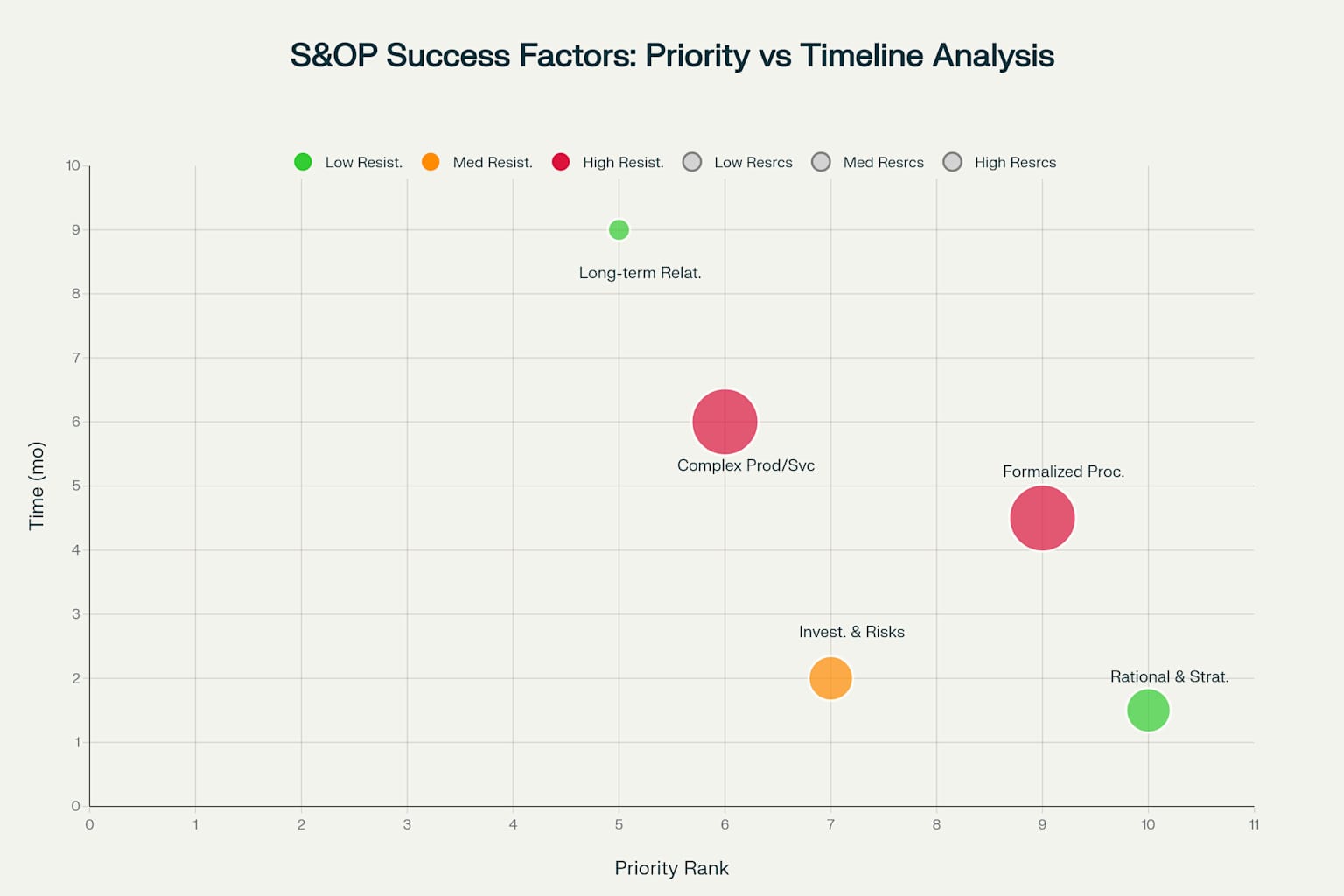
Strategic S&OP Implementation: Priority Rankings vs Timeline with Resistance Analysis
Color-Coded Resistance Analysis in S&OP Implementation
Low Resistance Factors (Green): Strategic Entry Points
Rational and Strategic Criteria
This factor represents the ideal starting point for S&OP implementations, combining the highest priority (10/10) with minimal resistance. Implementation typically requires only 1–2 months and a medium level of resource allocation, making it an efficient foundation for team alignment. The low resistance is attributed to the objective, measurable nature of ROI calculations and KPI definitions, which provide clear decision-making frameworks and minimize emotional opposition.
Long-term Relationships
While this factor exhibits similarly low resistance, it ranks lowest in priority (5/10) among the five factors. Implementation spans 6–12 months but demands minimal resources and generates little immediate friction due to its future-oriented focus. The strategic value lies in building sustainable partnerships without disrupting current team dynamics.
Medium Resistance Factor (Orange): Balanced Approach Required
Higher Investment Amounts and Risks
This factor occupies the middle ground, with moderate resistance and a priority ranking of 7/10. Implementation requires 1–3 months and medium resource allocation, representing a manageable challenge that benefits from a robust business case. Resistance arises because, while budget decisions can be justified rationally, financial discussions often introduce organizational tension.
High Resistance Factors (Red): Intensive Change Management Essential
Longer and Formalized Processes
This is a classic example of the priority-resistance paradox, ranking second in importance (9/10) but exhibiting high resistance. Implementation demands 3–6 months and substantial resources due to the disruptive impact on established workflows and comfort zones. High resistance stems from the fundamental changes required in daily operations and governance structures.
More Complex Products and Services
Here, technical complexity drives coordination challenges, with a priority ranking of 6/10 and high resistance. Implementation requires 4–8 months and significant resource allocation, reflecting the intensive collaboration needed between specialized departments. Resistance typically results from disagreements over technology integration and tool selection.
Strategic Implementation Framework
Phase-Based Deployment Strategy
The analysis underscores the necessity for a differentiated implementation approach based on resistance levels.
- Low-resistance factors should serve as entry points, leveraging minimal opposition to build momentum and secure early wins.
- High-resistance elements demand robust change management and enhanced communication protocols. Formalized processes, despite their critical importance, require comprehensive stakeholder engagement and systematic change management to overcome resistance.
Priority vs. Resistance Paradox
A noteworthy organizational behavior pattern emerges: high-priority factors often face high resistance, whereas the top-priority factor encounters minimal opposition. Objective, measurable criteria typically provoke less emotional resistance than process changes that disrupt established workflows. This insight is vital for strategic sequencing in implementation planning.
Resource Optimization Insights
Visualization of resource requirements reveals that high-resistance factors generally necessitate greater resource commitments. This correlation highlights the need for careful budget planning and stakeholder preparation to ensure sustainable implementation success.
Implementation Recommendations
Entry Point Strategy:
Initiate implementations with rational and strategic criteria to establish clear decision-making frameworks and foster organizational alignment. This approach leverages low resistance and creates measurable success metrics to support subsequent phases.
Resistance Management:
Develop intensive change management protocols for formalized processes and complex products/services. Recognize their high resistance but critical importance for long-term success. Enhanced communication and systematic stakeholder engagement are essential to overcome barriers.
Timeline Coordination:
Implementation timelines range from 1–2 months (low-resistance factors) to 4–8 months (high-resistance elements). Strategic coordination enables overlapping phases, maximizing resource efficiency while managing organizational change capacity.
Conclusion
This comprehensive, data-driven analysis provides actionable insights for effective S&OP group management. By strategically sequencing implementations based on resistance levels and resource requirements, leaders can optimize change processes, secure early wins, and drive sustainable organizational transformation.